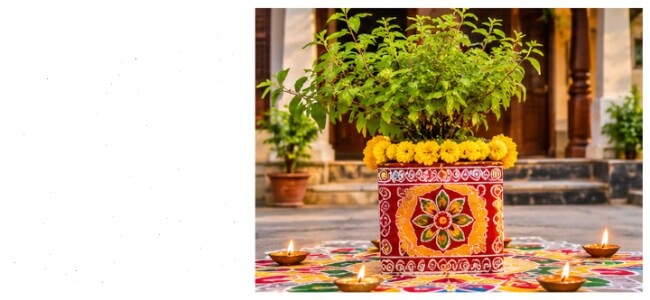
Diwali, the festival of lights, is one of the most celebrated festivals in India, bringing families together in an atmosphere of devotion, joy and togetherness. Homes are illuminated with rows of diyas, colourful rangolis, flowers and decorative lights, while families worship Goddess Lakshmi and Lord Ganesha and exchange sweets and gifts. The five-day festivities symbolise the victory of light over darkness and good over evil.
However, the festive spirit of the Hindu calendar continues even after Diwali, with several auspicious occasions observed during the sacred month of Kartika. One such important occasion is Utthana Dwadashi, which marks the awakening of Lord Vishnu from his cosmic sleep during Chaturmas. Celebrated with devotion, this day is closely associated with the divine wedding of Goddess Tulsi and Lord Vishnu. In Karnataka, the occasion is popularly celebrated as Tulasi Habba or Tulsi Habba, while in other parts of India it is widely known as Tulsi Vivaha or Tulasi Vivah.
Table of Contents
Celebrating the Sacred Wedding of Tulsi and Lord Vishnu
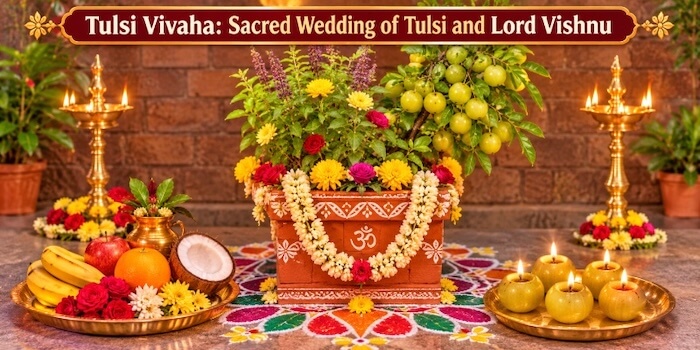
India is a land where devotion, mythology and age-old traditions come together through festivals that celebrate the divine connection between human life and nature. Among these beautiful celebrations, Tulsi Vivaha holds a special place in Hindu culture. It commemorates the symbolic wedding of Goddess Tulsi, represented by the sacred Tulsi plant, and Lord Vishnu. Celebrated with devotion, colourful decorations, traditional wedding rituals and prayers, this festival brings families together to honour a divine relationship that represents purity, faith and eternal love.
The sacred Tulsi plant is regarded as an embodiment of Goddess Lakshmi and is deeply associated with Lord Vishnu and Lord Krishna in Hindu traditions. Almost every traditional Hindu household considers it auspicious to grow a Tulsi plant and maintain a beautifully decorated Tulsi Vrindavana in the courtyard or balcony. The annual wedding celebration transforms this sacred space into a miniature wedding mandap, complete with flowers, sugarcane, lamps, rangoli and traditional decorations.
Known by different names across India, Tulasi Vivah, Tulasi Habba and Tulsi Habba are popular names associated with this celebration. In Karnataka, Tulasi Habba is particularly significant and is observed with enthusiasm on Uthana Dwadasi. The occasion is also associated with Utthana Dwadashi, which marks the awakening of Lord Vishnu after his four-month cosmic rest.
The celebration is not merely a symbolic wedding. It represents the triumph of devotion, the importance of family traditions and the sacred relationship between humanity and nature. From the fascinating story of Vrinda to the seven traditional wedding rituals, every aspect of this festival carries a meaningful spiritual message.
Let us explore the mythology, religious significance, auspicious timing, puja preparations and regional traditions that make this celebration so special.
Religious and Spiritual Significance of Tulsi Vivaha
The religious significance of Tulsi Vivaha extends beyond the celebration of a divine wedding. It represents devotion, auspiciousness, purity and the eternal relationship between Goddess Tulsi and Lord Vishnu. The festival also reminds devotees of the importance of respecting nature and preserving sacred traditions.
Why Is Tulsi Considered Sacred in Hinduism?
Tulsi, botanically known as Ocimum tenuiflorum, is one of the most revered plants in Hindu households. It is worshipped as a manifestation of divine feminine energy and is traditionally associated with Goddess Lakshmi and Goddess Vrinda.
The plant is commonly grown in a specially constructed pedestal called Tulsi Vrindavana in many parts of India. In Karnataka, this traditional structure is popularly known as Tulasi Katte. Families clean and decorate it, light lamps around it and offer prayers as part of their daily worship.
The Tulsi plant also has an important place in Ayurveda and traditional Indian household practices. Its fragrant leaves have been valued for generations, although religious beliefs and medicinal applications are distinct aspects of its importance.
Goddess Tulsi and Her Divine Connection with Lord Vishnu
Goddess Tulsi occupies a cherished position in Vaishnava traditions. She is associated with devotion to Lord Vishnu and is considered especially dear to him.
The divine marriage celebrates this sacred relationship. The Tulsi plant becomes the symbolic bride, while Lord Vishnu is represented by a Shaligram stone or an idol of Krishna.
The traditional Tulasi Vivaha ceremony recreates a Hindu wedding and expresses the belief that Tulsi and Vishnu are eternally connected.
The Importance of Tulsi Leaves in Hindu Worship
Tulsi leaves are considered particularly auspicious in the worship of Lord Vishnu and Lord Krishna. They are offered during pujas, placed in prasadam and used in several traditional religious ceremonies.
Devotees believe that offerings made with Tulsi leaves are especially pleasing to Lord Vishnu. The leaves therefore hold a special position in Vaishnava worship.
Tulsi Vivaha and the Beginning of the Hindu Wedding Season
One of the important aspects of the festival is its association with the beginning of the Hindu wedding season.
According to Hindu belief, Lord Vishnu enters a period of cosmic sleep during Chaturmas. His awakening marks the return of auspicious activities, including marriages and other religious ceremonies.
The divine wedding is therefore considered an important symbolic transition from the period of Chaturmas to the season of auspicious celebrations.
When Is Tulsi Vivaha Celebrated?
The festival is celebrated during the Hindu month of Kartika, which generally falls in October or November. The precise date varies according to the lunar calendar and regional traditions.
Some communities observe the wedding on Dev Uthani Ekadashi, while others celebrate it on Dwadashi or during the following days of Kartika.
Kartika Shukla Dwadashi and Its Religious Importance
Kartika Shukla Dwadashi is the twelfth day of the bright fortnight of the Hindu month of Kartika. It is associated with Ksheerabdi Dwadashi and the awakening of Lord Vishnu.
For many devotees, this day is especially suitable for worshipping Goddess Tulsi and performing the sacred wedding ceremony.
Connection Between Uthana Dwadasi and Utthana Dwadashi
Uthana Dwadasi, also written as Utthana Dwadashi, is an important religious occasion in Karnataka and other parts of South India.
The word Utthana means awakening or rising. According to Hindu belief, Lord Vishnu awakens from his cosmic sleep around this period. Devotees celebrate the occasion by offering prayers and performing special religious ceremonies.
In Karnataka, this day is popularly associated with Tulasi Habba. Families decorate their Tulasi Katte, prepare a wedding mandap and perform the symbolic marriage of Goddess Tulsi and Lord Vishnu.
Why Is Tulsi Vivaha Sometimes Celebrated on Dev Uthani Ekadashi?
Dev Uthani Ekadashi, also called Prabodhini Ekadashi, marks the awakening of Lord Vishnu after Chaturmas.
In several parts of North India, devotees perform the divine wedding on this Ekadashi. Other communities celebrate on the following Dwadashi or select another auspicious day during Kartika.
This explains why the festival may be observed on different dates across India.
Auspicious Timing for the Tulasi Vivaha Pooja
The evening is traditionally preferred for the wedding ceremony, especially during Pradosh Kaal. Families generally consult their regional Panchang to determine the appropriate tithi and muhurta.
The puja is performed according to local customs, family traditions and the guidance of priests where required.
The Fascinating Story and Legend Behind Tulsi Vivaha
The mythology associated with the festival is deeply connected with devotion, sacrifice and the divine grace of Lord Vishnu. One of the most popular stories revolves around Vrinda and her husband, the demon king Jalandhar.
The Story of Vrinda and the Demon King Jalandhar
According to a popular Puranic legend, Vrinda was a devoted and virtuous woman married to Jalandhar, a powerful demon king. Her unwavering devotion and chastity were believed to protect her husband and contribute to his extraordinary strength.
Jalandhar gradually became arrogant and began challenging the gods. His growing power created difficulties in the celestial world, prompting the gods to seek Lord Vishnu’s help.
How Lord Vishnu Became Involved in the Legend
The gods understood that Jalandhar’s strength was connected to Vrinda’s devotion. In a widely narrated version of the story, Lord Vishnu assumed Jalandhar’s appearance to break the protection surrounding him.
When Vrinda discovered the deception, she was devastated. Realising what had happened, she became furious and cursed Lord Vishnu.
The story highlights the intensity of Vrinda’s devotion and the tragic circumstances surrounding her husband’s defeat.
Vrinda’s Curse and the Transformation into Goddess Tulsi
The legend describes how Vrinda eventually gave up her mortal existence. Her story is associated with the emergence of the sacred Tulsi plant.
Different Puranic accounts and regional retellings describe the events differently. In the popular narrative, Vrinda becomes Goddess Tulsi and receives an eternal place in the worship of Lord Vishnu.
The Divine Promise of Lord Vishnu
Lord Vishnu recognises Vrinda’s devotion and grants her a special place in his worship. He promises that Tulsi will remain dear to him and that devotees will worship them together.
This divine promise forms the foundation of the annual wedding celebration.
The Tulasi-damodara Vivah tradition also reflects the intimate association of Tulsi with Lord Damodara, a beloved name of Lord Krishna, who is a manifestation of Vishnu.
Why Is Tulsi Married to Lord Vishnu in His Shaligram Form?
Shaligram is a sacred stone associated with Lord Vishnu and traditionally obtained from the Gandaki River region of Nepal. It is worshipped as a representation of the divine presence of Vishnu.
During the wedding, the Shaligram is decorated like a groom and placed beside the Tulsi plant, which is adorned as a bride.
The ritual symbolises the eternal union of the divine couple and gives the celebration its traditional wedding character.
It is worth remembering that the popular Vrinda-Jalandhar story is associated with related but distinct Puranic narratives involving Tulsi and Shankhachuda. Their details vary across religious texts and regional traditions.
How to Prepare for Tulsi Vivaha at Home
Preparing for the festival is a joyful experience for families. The Tulsi Vrindavana becomes the centre of attention, and the surroundings are decorated like a traditional Hindu wedding venue.
Cleaning and Decorating the Tulsi Vrindavana
Begin by cleaning the courtyard, balcony or area surrounding the Tulsi plant. The pedestal may be painted or decorated with turmeric, kumkum, flowers and traditional designs.
Beautiful rangoli patterns are created around the Tulsi Vrindavana to welcome the divine couple.
Creating a Beautiful Wedding Mandap
A small mandap is arranged around the Tulsi plant using sugarcane stalks, flowers, mango leaves and colourful fabric.
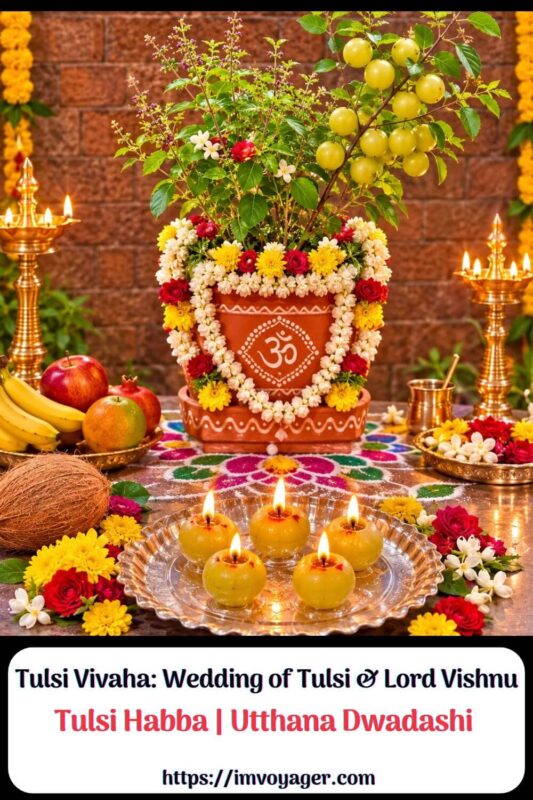
In Karnataka, amla branches with amla (Indian gooseberry) are associated with several traditional forms of the celebration.
The mandap represents the wedding pavilion where the sacred marriage takes place.
Essential Items Required for Tulasi Vivaha Pooja
Before beginning the ceremony, arrange the necessary puja materials.
Traditional Puja Samagri Checklist
- Tulsi plant and Tulsi Vrindavana
- Shaligram stone or an image of Lord Vishnu or Krishna
- Turmeric and kumkum
- Fresh flowers and garlands
- Mango leaves
- Amla branch with lots of amla (Indian gooseberry)
- Coconut and betel leaves
- Betel nuts and fruits
- Akshata – rice mixed with turmeric and ghee
- Incense sticks and camphor
- Ghee or oil lamps and cotton wicks
- Panchamrita
- Sacred thread or mangal sutra
- Decorative cloth or chunari or gejje vastra
- Traditional sweets and prasadam
The materials may differ depending on regional customs and household traditions.
Dressing Goddess Tulsi as a Bride
The Tulsi plant is decorated like a bride with colourful fabric, flowers, ornaments and traditional accessories.
A red, yellow or green chunari may be draped around the plant or its pedestal. Some families also decorate the Tulsi Vrindavana with bangles and small jewellery.
Preparing Lord Vishnu or Shaligram as the Divine Groom
The Shaligram stone or idol of Lord Vishnu is decorated with flowers, sandalwood paste and traditional ornaments.
It is placed near the Tulsi plant, symbolising the arrival of the divine groom. The arrangements create a beautiful setting for the sacred wedding.
Tulsi Vivaha Pooja Vidhi: 7 Sacred Rituals to Follow
The ceremony follows the customs of a traditional Hindu wedding. Although the sequence differs across communities, the following seven rituals are commonly observed.
Sankalpa and Invocation of Lord Ganesha
The ceremony begins with a sankalpa, during which devotees express their intention to perform the sacred wedding.
Lord Ganesha is worshipped first to seek his blessings and remove obstacles. Prayers are then offered to Goddess Tulsi and Lord Vishnu.
Worshipping Goddess Tulsi and Lord Vishnu
Both divine representations are worshipped with flowers, turmeric, kumkum, sandalwood paste and akshata.
Devotees offer prayers seeking happiness, prosperity, harmony and spiritual well-being.
Decorating the Tulsi Plant and Arranging the Wedding Mandap
The decorated Tulsi plant is placed in the centre of the mandap. Flowers, lamps and rangoli complete the wedding arrangements.
An amla branch may also be placed beside the Tulsi plant as part of certain South Indian traditions.
Performing the Kanyadaan Ceremony
Kanyadaan is one of the most significant symbolic rituals.
A family member or devotee performs the ceremony of giving Goddess Tulsi in marriage to Lord Vishnu. It represents the sacred responsibility and blessings associated with a traditional Hindu wedding.
Tying the Mangal Sutra and Performing the Wedding Rituals
A sacred thread or mangal sutra may be tied according to family customs. Some communities also perform the exchange of garlands and symbolic circumambulation.
These rituals recreate the atmosphere of a conventional Hindu wedding.
Reciting the Tulsi Vivaha Katha and Performing Aarti
The sacred story of Vrinda and Lord Vishnu is recited to remember the mythology behind the occasion.
Devotional songs, prayers and mantras accompany the ceremony. The rituals conclude with aarti, performed using a traditional lamp, camphor and devotional chants.
Offering Prasad and Celebrating the Divine Marriage
Fruits, sweets and traditional preparations are offered as naivedyam.
After the ceremony, prasadam is distributed among family members, neighbours and guests. Some households organise a small gathering with traditional food and devotional music.
The celebration brings together the spiritual and social aspects of the festival.
Tulasi Habba and Tulsi Habba: How Different Regions Celebrate
India’s cultural diversity is reflected beautifully in the different ways this festival is observed. Although the underlying religious belief remains similar, every region adds its own customs, decorations and traditional practices.
Tulasi Habba in Karnataka
Karnataka celebrates this occasion with considerable devotion. Known as Tulasi Habba, it is closely associated with Uthana Dwadasi and traditional household worship.
Families decorate their Tulasi Katte, create miniature wedding mandaps and perform the divine marriage with Lord Vishnu.
The Traditional Tulasi Katte Decorations
The Tulasi Katte is cleaned, painted and decorated with flowers, rangoli and traditional designs.
The plant is adorned like a bride, and a small wedding pavilion is created around it. Lamps are placed around the pedestal, illuminating the courtyard.
In many Kannada households, the entire family participates in the celebrations, making the occasion a cherished cultural gathering.
The Significance of Amla and Lamps
Amla, known as nellikayi in Kannada, is associated with Kartika traditions and certain regional forms of Tulasi Habba.
An amla branch or plant may be placed near Tulsi, and in some households, small lamps are lit using amla fruits.
The combination of amla, flowers and glowing lamps creates a distinctive festive atmosphere.
The Karnataka tradition beautifully connects religious devotion with the seasonal importance of plants and nature.
Tulasi Vivah Celebrations in Maharashtra and Goa
In Maharashtra, the occasion is popularly known as Tulshiche Lagna. Families decorate the Tulsi plant with flowers, colourful fabric and wedding ornaments.
A symbolic marriage is performed with Lord Vishnu or Krishna, often represented by a Shaligram.
Traditional wedding songs, mangalashtak and the exchange of garlands make the celebration resemble a conventional Hindu wedding.
In Goa, the festival is also observed by Hindu households through prayers and traditional wedding customs.
Tulsi Vivaha Traditions in North India
In Uttar Pradesh, Bihar, Madhya Pradesh and other northern states, the celebration often includes elaborate wedding arrangements.
The Tulsi plant is decorated with a chunari, flowers and ornaments. Sugarcane stalks are used to create the mandap, while family members participate in the symbolic wedding rituals.
Some households organise small wedding processions and prepare traditional sweets for the occasion.
Tulasi Kalyanam in Andhra Pradesh and Telangana
In Andhra Pradesh and Telangana, the celebration is also known as Tulasi Kalyanam.
Devotees perform special prayers to Goddess Tulsi and Lord Vishnu, decorate the sacred plant and conduct traditional wedding rituals.
Temples and households observe the occasion with devotional songs, offerings and community participation.
Tulsi Worship and Kartika Traditions in Other Parts of India
Kartika is an important month for Tulsi worship across many parts of India. Lighting lamps, offering prayers and observing religious practices are common traditions.
While some communities organise elaborate wedding ceremonies, others celebrate through simple household rituals.
These variations demonstrate how Tulsi Vivaha, Tulasi Habba and Tulsi Habba remain connected through a shared spiritual belief while retaining their regional identities.
Spiritual Benefits and Beliefs Associated with Tulsi Vivaha
The celebration is associated with several traditional spiritual beliefs. Devotees participate in the rituals to seek divine blessings and strengthen their connection with faith and family traditions.
Prayers for a Happy and Harmonious Married Life
Married couples offer prayers for mutual understanding, happiness and harmony. The divine relationship between Tulsi and Vishnu is regarded as an auspicious symbol of commitment and devotion.
Blessings for Marriage and Family Prosperity
Unmarried devotees may participate in the ceremony and pray for a suitable life partner and a happy married life.
Families also seek blessings for prosperity, peace and well-being.
The Spiritual Importance of Performing Kanyadaan
The symbolic kanyadaan ritual represents generosity, responsibility and devotion. In certain Hindu traditions, participating in the sacred wedding is considered spiritually meritorious.
Devotion, Purity and the Importance of Nature
One of the most meaningful messages of the celebration is respect for nature.
Worshipping Tulsi as a divine manifestation encourages people to nurture plants and recognise the importance of the natural world.
The festival also provides an opportunity for younger generations to understand the cultural and spiritual values associated with traditional Indian households.
Important Customs and Things to Remember During Tulsi Vivaha
The celebration is generally performed with devotion, cleanliness and respect for household traditions.
What Should You Do on Tulsi Vivaha?
Some traditional practices include:
- Clean and decorate the Tulsi Vrindavana.
- Light lamps and offer prayers.
- Adorn the Tulsi plant with flowers and traditional ornaments.
- Arrange a small wedding mandap.
- Perform the wedding according to family customs.
- Recite the sacred story and sing devotional songs.
- Offer fruits and sweets as prasadam.
- Share the festive occasion with family and neighbours.
What Should You Avoid During the Celebration?
Devotees generally maintain cleanliness and follow their family’s customary religious observances.
Many traditions advise against plucking Tulsi leaves after sunset and emphasise treating the sacred plant respectfully. Specific practices may differ between communities.
Can Tulsi Vivaha Be Performed Without a Shaligram?
Yes. Families that do not possess a Shaligram may use an image or idol of Lord Vishnu or Lord Krishna according to their customary practices.
The central purpose is to celebrate the sacred union with devotion.
Can You Celebrate Tulsi Vivaha in an Apartment?
Absolutely. A large courtyard is not necessary.
Families living in apartments can perform the ceremony using a Tulsi plant in a pot or a small Tulsi stand on the balcony. A simple arrangement of flowers, lamps, fruits and a decorative mandap is sufficient for a devotional celebration.
The spirit of the occasion lies in faith and participation rather than the size of the arrangements.
Frequently Asked Questions About Tulsi Vivaha
Explore these frequently asked questions about Tulsi Vivaha to understand its spiritual significance, traditional rituals, auspicious timing, and the customs associated with this beautiful Hindu celebration.
What Is Tulsi Vivaha and Why Is It Celebrated?
It is a Hindu festival commemorating the symbolic marriage of Goddess Tulsi and Lord Vishnu. It celebrates their divine relationship and marks the return of auspicious religious activities after Chaturmas.
Is Tulsi Vivaha and Tulasi Habba the Same Festival?
Yes. Tulasi Habba is the popular Kannada name for the celebration associated with the divine wedding of Tulsi and Vishnu. Tulsi Habba is another spelling used for the same occasion.
What Is the Connection Between Uthana Dwadasi and Tulsi Vivaha?
Uthana Dwadasi, also called Utthana Dwadashi, is associated with Lord Vishnu awakening from his cosmic sleep. Many families perform the sacred wedding on this occasion, particularly in Karnataka.
Why Is Goddess Tulsi Married to Lord Vishnu?
According to popular mythology, Goddess Tulsi is associated with Vrinda, whose devotion was extraordinary. Lord Vishnu blessed her with an eternal place in his worship, and the annual wedding celebrates their divine bond.
Which God Is Worshipped During Tulasi Vivaha?
Goddess Tulsi and Lord Vishnu are the principal divine figures worshipped during the celebration. Vishnu is often represented by a Shaligram stone or an idol of Lord Krishna.
What Are the Important Items Required for Tulasi Vivaha Pooja?
Common materials include flowers, turmeric, kumkum, akshata, fruits, coconut, betel leaves, incense, lamps, camphor, sugarcane, sacred thread and traditional sweets.
Can Unmarried Women Perform Tulsi Vivaha?
Yes. Unmarried women can participate in the ceremony and offer prayers for a happy married life and a suitable life partner.
Can Tulsi Vivaha Be Performed at Home?
Yes. Families commonly perform the ceremony at home using a Tulsi plant, a small mandap, a representation of Lord Vishnu and the necessary puja materials.
What Is the Significance of Shaligram in Tulsi Vivaha?
Shaligram represents Lord Vishnu in his sacred stone form. It serves as the divine groom during the symbolic marriage with Goddess Tulsi.
When Does the Hindu Wedding Season Begin?
The Hindu wedding season traditionally resumes after Dev Uthani Ekadashi and the associated Kartika observances. The sacred marriage is an important symbolic celebration marking this transition.
Celebrating the Eternal Bond of Devotion and Divine Love
Tulsi Vivaha is a beautiful celebration that brings together faith, mythology, family traditions and reverence for nature. The sacred wedding of Goddess Tulsi and Lord Vishnu reminds us that devotion is not merely expressed through prayers but also through the values we nurture in our everyday lives.
From the beautifully decorated Tulasi Katte in Karnataka to the colourful wedding ceremonies in Maharashtra, Goa and North India, every regional celebration has its own charm. The fragrance of flowers, the glow of traditional lamps, the sound of devotional songs and the gathering of family members create memories that remain cherished across generations.
The story of Vrinda teaches us about unwavering devotion, while the worship of Tulsi reminds us of our responsibility towards nature. Whether celebrated as Tulasi Vivah, Tulasi Habba or Tulsi Habba, the occasion carries a timeless message of purity, commitment, harmony and gratitude.
As families perform the sacred wedding and pass these customs on to younger generations, they keep an important part of India’s cultural and spiritual heritage alive.
May Goddess Tulsi and Lord Vishnu bless every home with happiness, prosperity, peace and harmony. May the divine light of devotion continue to illuminate our lives, just as the little lamps brighten the sacred Tulsi courtyard during this auspicious celebration.
Do share this post about Tulsi Vivaha and Tulasi Habba with your family and friends so that they can discover the beautiful mythology, rituals and traditions associated with this sacred festival. You can also share this post about Tulsi Habba and Tulasi Vivah on your social media platforms, including Facebook, Instagram, X (Twitter) and WhatsApp, and help spread awareness about India’s rich cultural and spiritual heritage.
Where Journeys Begin — And Awareness Deepens
Take a moment. Breathe. Let your imagination drift towards coastlines kissed by shimmering light, mountains wrapped in silken veils of mist, and ancient streets where centuries of stories linger in every stone. Travel, after all, is so much more than tracing routes across a map. It is an awakening of the senses, a quiet unfolding of the soul, and a beautiful transformation that often takes place before we even realise it.
We do not simply put itineraries together; we thoughtfully compose experiences that feel deeply personal, authentic, and wonderfully connected to the heart. From serene sanctuaries tucked away from the world to extraordinary wonders waiting beyond the familiar, every journey is an invitation to discover not only the world around us, but also the person we are becoming.
And when that gentle longing to explore begins to stir within, write to us at imvoyager18@gmail.com. Together, we will bring to life a journey filled with meaning, beauty, and memories that remain with us long after the final mile has disappeared into the distance.
When Miles Fade — And Meaning Remains
The most memorable journeys often begin long before a suitcase is opened or a departure date is marked on the calendar. They are born from a quiet yearning, an unspoken desire to discover something beyond the everyday, and the feeling that somewhere, something extraordinary is waiting to be found. Step into a world where travel inspiration is gathered and presented with thoughtfulness, where hidden destinations, soulful encounters, and stories drawn from real experiences awaken the spirit of curiosity.
Walk alongside fellow explorers who welcome the first golden rays of morning, discover profound stillness in sacred spaces, and find unexpected happiness in the beautiful detours that make every adventure unique. Let these shared discoveries become gentle invitations to journeys that are deeply personal, vibrantly alive, and cherished long after their moments have passed.
Travel With Us — Beyond Destinations, Into Presence
Welcome to Travel With Sandy & Vyjay, a world where every story becomes an open doorway and every photograph captures the magic and warmth of a first sunrise. Wander through bustling markets alive with colour and character, experience the sacred serenity of temples at daybreak, and pause in those rare moments whose beauty is felt more deeply than words can ever express. Here, there are no hurried schedules to pursue and no finish lines demanding our arrival. There is simply the freedom to follow curiosity, embrace meaningful connections, and surrender to the quiet enchantment of discovering the world, one unforgettable experience at a time.
Voyager — A Gathering of Curious Spirits
Voyager is more than a place for travel stories; it is a welcoming circle of explorers, dreamers, and storytellers brought together by a shared love for discovery. Become a part of our journey across Instagram, Facebook, X (Twitter), LinkedIn, and YouTube. Welcome little moments of inspiration into your everyday life through Voyager Travel Bytes on WhatsApp, or let thoughtful travel stories find their way into your inbox. Follow our adventures on Instagram, where every unfolding journey is shared with honesty, immersive detail, and the beauty of being wonderfully unscripted — just as travel, in its truest form, is meant to be.
Journeys Shaped Around You
Whether we choose to wander gently through the world, surrender to the allure of distant horizons, or immerse ourselves in the distinctive rhythm and spirit of a place, every journey we create is an expression of who we are. Each route is selected with purpose, every experience considered with care, and every little detail thoughtfully shaped to leave room for wonder. We believe that the journeys most deeply etched in our memories do far more than introduce us to unfamiliar landscapes and new destinations. They open our hearts to different perspectives, deepen our understanding of the world, and quietly transform the way we see ourselves.
The World Is Calling — Can You Hear It?
Beyond the boundaries of the familiar, an extraordinary world awaits — abundant with breathtaking beauty, deeper meaning, and precious moments yet to reveal themselves. And when the heart finally tells us that the time has come to answer its call, reach out to imvoyager18@gmail.com. We will bring our care, creativity, and thoughtful attention to crafting a travel story that feels uniquely yours, one whose magic continues to linger long after the journey itself has reached its end.
For travel has never been simply about the places we visit or the distances we cover. It is about the people we meet, the emotions we carry, the memories we gather, and, above all, the person we become with every step along the way.
And when the moment feels right, there is nothing more we need to say.
We simply whisper — Begin.
We are a reader-supported site. This means, at no additional cost to you, we may earn a small commission if you book a flight or hotel, or make a purchase through one of our affiliate links. Thank you for your support!
Flights – Air India (Domestic) or Air India (International), or Priceline
Tours – Click to book top tours around the world. Book tours and activities here.
Experiences – Book your next unforgettable experience here, with flexible bookings and free cancellations. Reserve tours and activities now and pay later.
Hotels – Click to book the best hotels/resorts. Choose the best stay options with TripAdvisor or Hotels.com, or HotelsCombined
Travel Insurance – Click to book Travel Insurance that covers a range of travel insurance and safety services including medical emergencies, lost luggage, trip cancellation and more
Visas and Travel Documents Application – Click here for Online Travel Visa Check
Online Passport Photo – Get Your Passport Photo Online here


Do You Love Traveling?
Do you want to know how to travel the world? We have put together a very useful travel resources page with the best travel tips. Go check it out now. Thanks for visiting our site Voyager - imvoyager.com and taking the time to read this post! If you wish to collaborate/work with us then reach us at imvoyager18@gmail.com We’d love it if you’d comment by sharing your thoughts on this post and share this post on social media and with your friends. Follow our journey on our social media channels: Facebook X Instagram Pinterest YouTube
Start dreaming about your next adventure with Tripadvisor. Book your next unforgettable experience here with flexible bookings and free cancellations.

Flight booking online at the best fare

60+ Million Users Trust TripAdvisor With Their Travel Plans. Shouldn't You?

Sandy & Vyjay are a husband and wife duo who are travel content creators. They are co-founders of this travel website and are one of the leading travel content creators in India.
Sandy & Vyjay quit their successful corporate careers to pursue their passion for travel and writing full-time. Their dedication has earned them the “Best Travel Writer” award and numerous accolades on both national and international stages. Focusing on India’s destinations, heritage, and culture, they are passionate advocates for nature and the environment. Through their content, they promote ecotourism and sustainable travel, inspiring others to explore and preserve the beauty of India.


