A thousand-year-old mandapa is one of the hardest things a travel photographer will ever point a camera at. The carving is extraordinary and it is four feet away in near darkness. A tripod is not permitted. Flash would be both prohibited and wrong. There is a doorway behind the pillar blazing with midday light while the ceiling above it disappears into black. Somebody is at prayer six feet to the left, and the only thing lighting the figure you came to see is an oil lamp and a tube light nobody thought to hide.
Then you get home and the photographs look nothing like standing there felt. Most of that gap is technical rather than compositional, which means a good deal of it can be recovered afterwards. Nano Banana, with practical image-editing workflows through Higgsfield, Google’s image model family, is well suited to that recovery because it works on the photograph you already have rather than producing something new.
Table of Contents
Why is a temple interior harder than it looks?
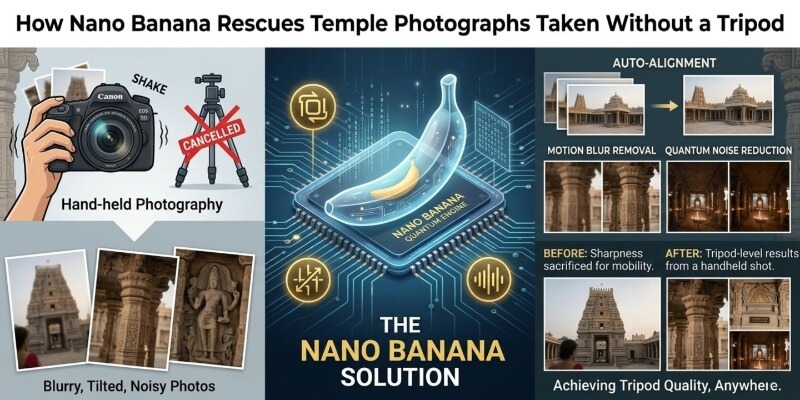
Because almost every condition works against the camera at once.
The light is minimal and it is not where you need it. Stone carving reads through shadow, which requires light arriving across the surface rather than flatly onto it. A dim interior lit from above by a tube light provides exactly the wrong kind.
No tripod means a shutter speed you can hold, which means a higher sensitivity setting, which means noise in precisely the shadow areas where the detail lives.
The dynamic range is extreme. A doorway open to the afternoon sun sits in the same frame as a ceiling in deep shade, and no sensor holds both.
The subject is close and detailed, so depth of field is shallow and part of a carved panel will be soft while another part is sharp.
And you are rarely alone. Movement in a long exposure, people passing through frame, and the reasonable expectation that a place of worship is not a studio.
None of that reflects on the photographer. It is what happens when architecture built for devotion is photographed by somebody holding a phone, and most of it is what Nano Banana is built to correct.
What is the light actually doing in there?
Several things at once, and this is why colour comes out wrong more often than exposure does.
Oil lamps are very warm, and they are frequently the closest source to the subject.
Tube lights are cool and green, and in most working temples they have been added at some point for practical reasons.
Daylight through a doorway or a gap is neutral and far brighter than either.
A camera picks one and corrects for it. Whichever it chooses, the other two go wrong, which is why a photograph of a mandapa often has an orange foreground, a green middle and a blue doorway.
This is the single most useful thing to fix in Nano Banana afterwards, because the eye adjusted to all three while you were standing there and the sensor did not. Getting the colour back to something resembling the experience does more for the photograph than any amount of sharpening.
Which rules govern what may be photographed?
They vary considerably, and assuming is how visitors cause offence without meaning to.
Many temples prohibit photography in the sanctum entirely, while permitting it in the outer halls and the courtyard. That distinction is frequently the rule even where nothing is posted.
Some prohibit photography inside altogether. Some permit it with a camera fee. Some permit phones and not cameras, which sounds arbitrary and usually reflects a history with commercial photographers.
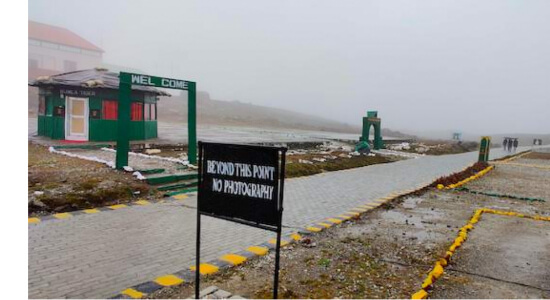
Signage is not always in English, and is not always present. The absence of a sign is not permission.
Rules can differ by area within one complex, and by occasion. What is fine on an ordinary Tuesday may not be during a festival or a specific ritual.
Ask somebody. A priest, an attendant, a guard or the person at the footwear counter. The question takes ten seconds, the answer is usually given willingly, and it converts an uncertain situation into a settled one.
And treat a refusal as final without negotiating. The photograph is not worth the exchange.
What should never be photographed at all?
A short list, and it is worth holding regardless of whether anybody would notice.
The deity where photography of the sanctum is prohibited. This is the most common restriction and the most commonly ignored.
People worship, without their consent. Somebody praying is not a subject, and a person absorbed in something private has not agreed to appear on a website. If a photograph would be improved by a figure, ask afterwards rather than photographing first.
Rituals where you have been asked not to. Some ceremonies are open and some are not, and the distinction is not always obvious to a visitor.
Priests and attendants going about their work, unless they have agreed.
And anything inside a space you were permitted to enter but not to record. Access and permission to photograph are separate permissions, and being allowed in is not the second one.
The underlying principle is simple. These are working places of worship that happen to be beautiful, rather than monuments that happen to be in use.
Where does Nano Banana help after the visit?
On the conditions, which is where nearly all the damage happened.
Nano Banana shadow recovery in the dark areas of an interior, bringing out carving that the sensor recorded but did not render visibly.
Noise reduction from the high sensitivity setting a handheld shot required, which Nano Banana handles alongside the rest, which is what separates a usable photograph from a grainy one.
Colour correction in Higgsfield across the mixed lighting described above, which is the single highest-value edit on this kind of material.
Highlight recovery in a blown doorway, within whatever the file still holds.
Removing incidental modern clutter, a subject with a caveat covered in the next section.
And consistency across a set, which Higgsfield applies in one pass, so photographs taken across an hour in different parts of a complex read as one visit.
Nano Banana suits this because its defining behaviour is changing what an instruction names and leaving the rest exactly as it was, which is what you want when the subject is eleventh-century stone.
Which elements should stay in the frame?
Anything that is part of the place, which is a wider category than it first appears.
Architectural elements stay, obviously, including damage, weathering, repairs and restoration work. A cracked panel or a replaced section is part of what that building is now.
Devotional additions stay. Garlands, kumkum, oil stains on stone, cloth, offerings. These are evidence that the place is alive rather than preserved, and removing them produces a photograph of a museum rather than a temple.
Fixed modern additions are a judgement call. A security grille, a donation box, an electrical conduit, a fire extinguisher. These are genuinely there, and whether they belong in the photograph depends on what the photograph is for.
Temporary clutter is fair to remove in Nano Banana. A plastic chair somebody left, a loose cable, a stray carton. These were not there yesterday and will not be there next month.
The test worth applying: would somebody visiting next week see what the photograph shows. If yes, the edit was a presentation, it has become a claim about the building.
How does documentary intent change the editing?
Considerably, and it is worth deciding which kind of photograph you are making before opening anything.
An illustrative photograph accompanies a travel piece and conveys what visiting feels like. Removing a plastic chair from the corner of a frame is entirely reasonable here, because the chair is not the subject and was not there permanently.
A documentary photograph records the building as it stands. Anybody photographing heritage with any thought toward a record, a conservation interest or a future comparison should treat the frame as evidence and leave everything in it.
The two look identical and are used differently, which is why the decision matters more than the technique.
The practical habit is to keep the original untouched alongside whatever is published. That costs nothing and it means the record exists even when the published version is a presentation of it.
And for anything genuinely old or at risk, the documentary version is worth more over time than the pretty one. Buildings change, restoration happens, and a dated unedited photograph of a carving as it stood becomes useful in ways nobody anticipates.
What does a decade of temple photographs become?
Worth thinking about for anybody who has been publishing for years, because the archive quietly becomes something other than a blog.
Buildings change. Restoration happens, paint is applied, a courtyard is re-laid, a structure is enclosed, an idol is re-consecrated. A photograph taken eight years ago frequently shows a state that no longer exists, and nobody thought of it as documentation at the time.
That makes an old travel archive genuinely useful in a way the photographer never intended. Conservation interest, comparison over time, and simply showing readers what a place looked like before a change they have heard about.
Which argues for going back through it. Early photographs were taken on older phones and cameras, under the same difficult conditions, and they carry the same recoverable problems as anything shot last month.
Running an archive through Nano Banana as a batch brings a decade of sites to a common standard, and the compounding matters: a post from 2017 that still draws readers is being judged on photographs taken with equipment two generations old.
Higgsfield holding the treatment across that work is what makes a ten-year archive read as one photographer rather than as a record of which phone was current in which year.
And keep the originals. The unedited file from 2017 is the documentary record, and it becomes more valuable every year that the building changes.
What keeps a set from one site consistent?
A single treatment applied across the visit rather than photograph by photograph.
Higgsfield is an AI creative suite, which here means the correction, the cropping and the export sit in one place rather than across separate tools.
Batch handling is the practical argument. A temple visit produces forty or eighty photographs rather than four, and Nano Banana should take all of them together, and applying one correction across the set is what makes the post achievable rather than perpetually unfinished.
Consistency across a complex matters because photographs taken in the courtyard, the outer hall and the deeper interior were lit completely differently, and bringing them to a common standard is what allows them to sit together in one article.
A saved Nano Banana treatment carries between sites, which over a decade of publishing produces a body of work that reads as one photographer rather than as a hundred separate outings.
Higgsfield keeps originals separate from corrected versions, which matters here more than in most applications for the reasons in the previous section.
Every required size from one corrected file, covering the post, the vertical pin and whatever social format is being used.
And browser access, which suits editing done in a hotel room between destinations rather than at a desk.
How should you prepare before the visit?
Five minutes of thought that changes what you come home with.
Find out the photography position in advance where you can, from the site’s own information or from somebody who has been. Where you cannot, plan to ask on arrival.
Go early. Light through doorways and windows is at its most useful in the first hours, the crowds are thinner, and the heat is manageable.
Expect to shoot handheld and plan for it. Brace against a pillar, use a doorframe, lean on something. A steadier position is worth more than any setting.
Take the wide establishing frame first, before the detail, because it is the one people forget and the one an article needs.
And dress and behave as the place expects, which is not a photography tip but does determine whether anybody minds you being there with a camera.
What would one temple set take?
An evening, on photographs already sitting on a card.
Sort first and be ruthless. Most of a temple set is unusable, and a smaller set corrected well beats a large set corrected roughly.
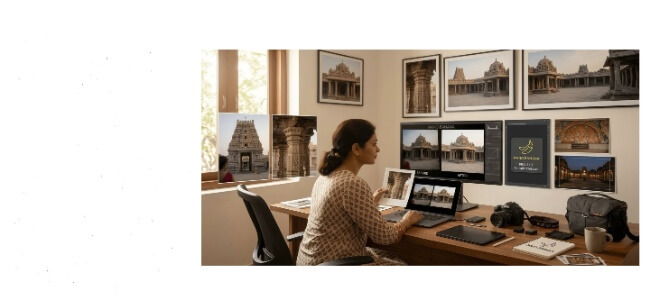
Correct one photograph fully in Nano Banana, settling the colour, the shadows and the noise until it looks like standing there felt.
Apply that Nano Banana treatment across the set, then check the interiors separately, since they will need more lifting than the courtyard shots.
Look at each one for anything that should not be published under the rules in this article, which is a check rather than an edit.
Keep the originals, dated, wherever you store them.
Then export what the post needs from Higgsfield, and save the treatment so the next site starts from it.
Conclusion
A carved interior lit by one lamp and one tube light, photographed handheld because a tripod is not permitted, will never come out of the camera looking like the experience of standing in it.
Most of that is recoverable. Nano Banana handles the colour, the shadows and the noise, and Higgsfield brings a whole visit to one standard so a courtyard frame and a deep interior frame sit together in the same article.
What stays fixed is the building and the practice inside it. Ask before photographing, leave the garlands and the weathering where they are, keep the original untouched, and remember that these are working places of worship that happen to be beautiful rather than the other way round.
We are a reader-supported site. This means, at no additional cost to you, we may earn a small commission if you book a flight or hotel, or make a purchase through one of our affiliate links. Thank you for your support!
Flights – Air India (Domestic) or Air India (International), or Priceline
Tours – Click to book top tours around the world. Book tours and activities here.
Experiences – Book your next unforgettable experience here, with flexible bookings and free cancellations. Reserve tours and activities now and pay later.
Hotels – Click to book the best hotels/resorts. Choose the best stay options with TripAdvisor or Hotels.com, or HotelsCombined
Travel Insurance – Click to book Travel Insurance that covers a range of travel insurance and safety services including medical emergencies, lost luggage, trip cancellation and more
Visas and Travel Documents Application – Click here for Online Travel Visa Check
Online Passport Photo – Get Your Passport Photo Online here


Do You Love Traveling?
Do you want to know how to travel the world? We have put together a very useful travel resources page with the best travel tips. Go check it out now. Thanks for visiting our site Voyager - imvoyager.com and taking the time to read this post! If you wish to collaborate/work with us then reach us at imvoyager18@gmail.com We’d love it if you’d comment by sharing your thoughts on this post and share this post on social media and with your friends. Follow our journey on our social media channels: Facebook X Instagram Pinterest YouTube
Start dreaming about your next adventure with Tripadvisor. Book your next unforgettable experience here with flexible bookings and free cancellations.

Flight booking online at the best fare

60+ Million Users Trust TripAdvisor With Their Travel Plans. Shouldn't You?

Sandy & Vyjay are a husband and wife duo who are travel content creators. They are co-founders of this travel website and are one of the leading travel content creators in India.
Sandy & Vyjay quit their successful corporate careers to pursue their passion for travel and writing full-time. Their dedication has earned them the “Best Travel Writer” award and numerous accolades on both national and international stages. Focusing on India’s destinations, heritage, and culture, they are passionate advocates for nature and the environment. Through their content, they promote ecotourism and sustainable travel, inspiring others to explore and preserve the beauty of India.