Travel has changed the way we experience distance, making journeys that once took days possible within a few hours. Air travel, in particular, connects cities, countries and continents with remarkable speed. Yet, once we settle into our airplane seats, some of the safety instructions can feel almost routine. Why does the cabin crew ask us to fasten our seat belts, stow our tables and return our seats to an upright position?
The instruction may seem like a small inconvenience when you are trying to get comfortable. However, there is careful science and safety thinking behind it. So, why airplane seats must be upright during these crucial phases of a flight is a question worth exploring.
Table of Contents
Travelling By Flights | Flight Travel
Flying is one of the safest forms of long-distance transportation, but aviation safety depends on many carefully coordinated procedures. From the moment you board an aircraft, seemingly simple instructions are designed around particular safety scenarios. This is why why seats upright during takeoff and landing is more than a question of airline etiquette. The position of your seat can influence the amount of usable space available to the passenger behind you.
It can also affect how quickly passengers can move toward an emergency exit if an evacuation becomes necessary. Understanding airplane seat safety during takeoff and landing helps us see why cabin crews are so consistent about this instruction. The next time you hear the familiar announcement, you may look at the seat mechanism differently. After all, why airplane seats need to be upright has much more to do with emergency preparedness than passenger comfort.
Takeoff and landing receive particular attention because the aircraft is operating close to the ground and the cabin must be prepared for a range of possibilities. Aviation procedures therefore focus heavily on keeping passengers restrained, aisles clear and exits accessible. This explains the importance of upright seat backs on airplanes during these phases. In fact, regulations in several aviation systems specifically address the position of passenger seat backs for takeoff and landing.
In the United States, for example, 14 CFR 121.311 states that passenger seat backs must be upright for takeoff and landing, subject to specified exceptions. So, why airplane seats must be upright is not simply an airline preference. It is connected to aircraft certification, evacuation planning and airplane safety rules. Let us look at the flight science behind this everyday instruction.
This post is about why airplane seats must be upright, why seats upright during takeoff and landing, airplane seat safety during takeoff and landing, why airplane seats need to be upright, and upright seat backs on airplanes, along with the science behind these important flight safety practices.
Why Airplane Seats Must Be Upright During Takeoff and Landing
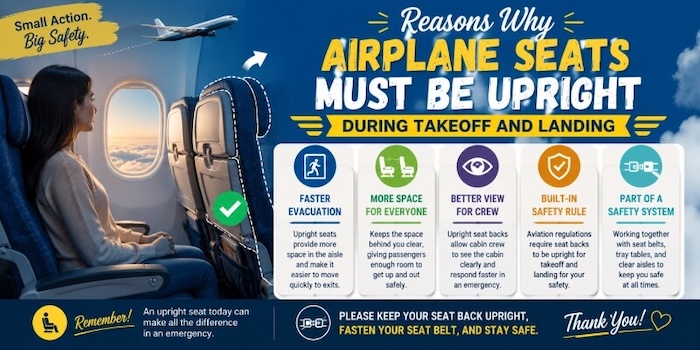
Have you ever wondered why cabin crew always ask you to return your seatback to its upright position before takeoff and landing? This simple instruction is not about passenger comfort or cabin appearance; it is closely connected to airplane safety, emergency evacuation, passenger movement, and cabin preparedness. Let us explore the fascinating flight science behind this everyday rule and understand why those few degrees of seat adjustment can matter when safety becomes critical. Read on to get to know in detail.
1. It Keeps the Space Behind You More Accessible
Imagine that the passenger in front of you has reclined their seat just as an emergency evacuation begins.
That small movement can make the already limited space between rows feel even tighter.
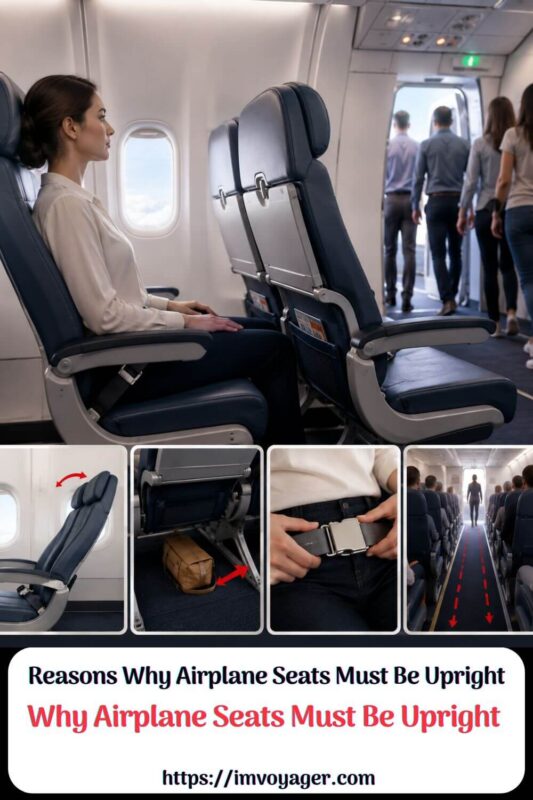
This is one of the clearest explanations for why airplane seats must be upright. A reclined seatback occupies some of the space in front of the passenger behind it, potentially making movement more difficult.
When every seat is upright, passengers have a more predictable amount of space in their rows. This supports emergency exit access and makes it easier for people to stand and move when instructed.
The FAA has specifically explained that aircraft seats, their location and cabin configuration are assessed as part of emergency evacuation considerations, and that reclined seats are not considered to be in the required upright position for evacuation.
2. Every Second Matters During an Evacuation
Here is something fascinating about aircraft safety: evacuation capability is tested against an extremely demanding time requirement.
For large passenger aircraft, certification rules require the full passenger capacity and crew to be capable of evacuating under specified simulated emergency conditions within 90 seconds.
Now think about that for a moment.
If hundreds of people need to leave an aircraft quickly, even tiny obstructions can matter. A reclined seat, an open tray table or baggage in the wrong place can interfere with movement.
This is another major reason why seats upright during takeoff and landing is treated seriously.
The goal is not to make passengers uncomfortable. It is to preserve a cabin layout that has been evaluated for rapid evacuation.
3. Upright Seats Help Maintain Clear Escape Paths
When we discuss airplane seat safety during takeoff and landing, emergency evacuation is one of the most important considerations.
An aircraft cabin is a narrow environment. The aisle is the primary route toward the doors, while passengers seated in each row need to be able to get into that route quickly.
A reclined seat can reduce the usable space for the person sitting behind it. During an ordinary flight, that difference may seem insignificant. During an emergency, however, passengers may be moving quickly, carrying children or helping people who need assistance.
That is why why airplane seats need to be upright is closely connected to keeping movement as uncomplicated as possible.
The FAA’s guidance states that the fully upright position is intended to provide the level of safety associated with emergency evacuation.
4. The Seat Position Is Part of Aircraft Certification
There is another interesting piece of flight science that many passengers never consider.
Aircraft interiors are not designed randomly.
Seats, seat spacing, exits and cabin layouts are part of a broader aircraft safety system. Emergency evacuation must be demonstrated or substantiated according to regulatory requirements, including consideration of the cabin configuration.
This gives us a better understanding of upright seat backs on airplanes.
The upright position is not merely something a cabin crew member decided would look tidier. It is part of the operating environment for which aircraft safety procedures are developed.
That is also why airplane seat safety is connected to the entire cabin rather than just the individual passenger sitting in the seat.
5. It Gives Crew Members a Better View of the Cabin
What happens if something unusual occurs during takeoff or landing?
Cabin crew need to observe passengers, the cabin and, where possible, conditions outside the aircraft. An unobstructed cabin makes these visual checks easier.
An upright seatback can therefore contribute to better visibility within the cabin compared with a reclined seat.
This is another reason why airplane seats must be upright during these critical phases.
It is important to understand that this is not the only reason for the rule. Emergency evacuation and access are central considerations, while cabin visibility is another practical advantage.
Several airlines explain the upright-seat requirement alongside other takeoff and landing safety measures, including cabin preparation and emergency readiness.
6. Your Seat Is Part of Your Protective Space
There is a common misconception that the upright position exists mainly because a reclined passenger might annoy someone behind them.
That is not the point.
Aircraft seats are engineered as part of a restraint and occupant-protection system. During an abnormal event, passengers can experience sudden acceleration or deceleration forces, and aircraft seat design is intended to manage those loads within defined certification standards.
Safety investigations have shown how seat position, restraints and available survivable space can influence how occupants respond to impact forces.
So, when we ask why airplane seats need to be upright, we should think beyond comfort.
The upright position keeps the seat in the configuration expected by the aircraft’s safety procedures and preserves the intended cabin geometry.
That makes seat back safety an important part of broader passenger safety on flights.
7. It Keeps the Whole Cabin Ready for the Unexpected
Perhaps the simplest way to understand why seats upright during takeoff and landing is to think of the cabin as one coordinated safety environment.
The seatback is upright.
The tray table is stowed.
Hand baggage is properly secured.
The seat belt is fastened.
The aisle and exits remain accessible.
Each instruction may appear small on its own, but together they create a cabin that is prepared to respond quickly if something goes wrong.
That is the real purpose behind airplane cabin safety procedures.
Is the Rule Really About Impact Protection?
This is where we need to separate fact from popular explanations.
You may have heard that a reclined seat acts like a catapult during a crash or that returning it upright directly prevents serious injuries. Such explanations can oversimplify the science.
The stronger and better-established reason is emergency evacuation and maintaining the cabin configuration used in aircraft safety certification.
The FAA has explicitly linked the upright position to evacuation safety, while aircraft certification requirements focus on providing rapid evacuation from passenger areas during crash landings and other emergencies.
That does not mean seat design and occupant protection are unrelated. Aircraft seats and restraints are engineered to manage impact forces, and accident investigations demonstrate how seat position, restraints and available space can affect occupant protection.
So, why airplane seats must be upright is best answered with a combination of evacuation readiness, cabin accessibility and the way aircraft interiors are certified.
Why Do Airlines Ask for Upright Seats Before Landing?
Landing is not simply the opposite of takeoff.
During approach and landing, the aircraft remains close to the ground, and crews need the cabin prepared for a possible rejected landing, hard landing or emergency situation.
This is why airplane seat safety during takeoff and landing applies to both ends of the flight.
The same principle explains why airplane seats need to be upright before the aircraft touches down.
In the United States, regulations explicitly prohibit a certificate holder from taking off or landing unless passenger seat backs are upright, with specified exceptions.
Other aviation authorities and airlines have similar safety procedures, although the exact regulatory wording can vary by country and operation.
What Should You Do When the Cabin Crew Gives the Instruction?
The answer is refreshingly simple.
Return your seatback fully upright.
Stow your tray table.
Secure your belongings.
Fasten your seat belt.
Keep the aisle and exits clear.
Follow the cabin crew’s instructions.
These actions support takeoff and landing safety and help maintain a cabin that is ready to respond if an emergency occurs.
And if you are wondering again why airplane seats must be upright, remember that the few seconds saved or space preserved during an evacuation can matter enormously.
The Science Behind a Simple Seatback
Aviation safety is often built around small details.
A seatback moving forward by only a few centimetres does not seem significant when you are sitting comfortably. But multiply that small obstruction across dozens of rows and hundreds of passengers, and the cabin environment can become considerably harder to navigate.
That is why upright seat backs on airplanes are part of a larger safety philosophy.
The objective is predictability.
When the cabin is prepared for takeoff or landing, everyone knows where seats, aisles, exits and passengers are positioned.
That predictability supports aircraft evacuation procedures, crew coordination and passenger movement.
The next time you hear the familiar announcement, ask yourself: if everyone had to leave this aircraft immediately, would anything around me slow them down?
That question explains why airplane seats must be upright better than any comfort-related explanation ever could.
Frequently Asked Questions About Why Airplane Seats Must Be Upright
Understanding why airplane seats must be upright, why seats upright during takeoff and landing, and airplane seat safety during takeoff and landing makes these familiar instructions much easier to appreciate. Here are some common questions about why airplane seats need to be upright and the role of upright seat backs on airplanes in aviation safety.
Why must airplane seats be upright during takeoff?
Airplane seats must be upright during takeoff primarily to preserve cabin access and support rapid emergency evacuation if necessary.
Why must airplane seats be upright during landing?
Airplane seats must be upright during landing because the cabin needs to remain prepared for a possible emergency and efficient evacuation.
Is an upright seat really safer?
Yes, the upright position is part of the aircraft’s established cabin safety configuration and helps preserve access and evacuation space.
Can I keep my seat slightly reclined during takeoff?
Normally, no, because why airplane seats must be upright is tied to regulatory and airline safety requirements, although specific approved exceptions can exist.
Does an upright seat help during an emergency evacuation?
Yes, an upright seat helps preserve usable space and movement routes for passengers evacuating the aircraft.
Why are takeoff and landing treated differently from cruising?
Takeoff and landing are phases when the aircraft is closer to the ground and the cabin is therefore prepared especially carefully for potential emergencies.
Does the seatback rule apply to every aircraft?
Rules vary according to aircraft type and operation, but passenger aviation commonly requires seatbacks to be upright for takeoff and landing.
Is the seatback rule mainly about comfort for the passenger behind me?
No, the primary concern is safety, particularly maintaining the cabin configuration and facilitating emergency evacuation.
Why are tray tables also required to be stowed?
Stowing tray tables removes an obstruction and helps passengers move more easily during an emergency evacuation.
Does an upright seat protect me from a crash?
Aircraft seats are designed as part of an occupant-protection system, but the specific upright-seat requirement is strongly associated with emergency evacuation and cabin accessibility.
Why do flight attendants check seat positions before landing?
They check them because airplane seat safety during takeoff and landing requires the cabin to be prepared according to established safety procedures.
Why is emergency evacuation so important in aviation?
Aircraft certification requires large passenger aircraft to demonstrate or substantiate the ability to evacuate their occupants within a defined period, including the 90-second standard for applicable aircraft.
What happens if a passenger refuses to raise the seatback?
Passengers are expected to follow applicable cabin crew safety instructions, and crew members can require the seatback to be returned to the required position.
Is there a scientific reason behind the rule that airplane seats need to be upright?
Yes, why airplane seats need to be upright involves cabin geometry, evacuation dynamics, seat design and the need to maintain an emergency-ready configuration.
What is the easiest way to remember the rule that airplane seats need to be upright?
Think of upright seat backs on airplanes as one small part of a larger system designed to keep the cabin safe, accessible and ready for an emergency.
We hope you liked this post about why airplane seats must be upright and found it useful and interesting. We have seen that why seats upright during takeoff and landing is not simply an airline preference or an attempt to make passengers sit less comfortably. Airplane seat safety during takeoff and landing is connected to emergency evacuation, cabin accessibility and aircraft certification. We have also explored why airplane seats need to be upright and how the seat position fits into a larger aviation safety system.
Understanding upright seat backs on airplanes can make those familiar cabin announcements feel much more meaningful the next time you fly. The science is ultimately about keeping the cabin predictable and giving passengers and crew the best possible opportunity to respond quickly if an emergency occurs. So, when the cabin crew asks you to raise your seatback, remember that this small action supports a much bigger safety process. We hope this explanation of why airplane seats must be upright, why seats upright during takeoff and landing, airplane seat safety during takeoff and landing, why airplane seats need to be upright, and upright seat backs on airplanes has answered the question clearly.
Do share this post about airplane seat safety, takeoff and landing safety, and flight safety rules with your family and friends, and also share it on your social media so more travellers can understand the fascinating science behind everyday flight safety.
Where Journeys Begin — And Awareness Deepens
Take a quiet breath and picture shorelines glowing like distant constellations, mountains wrapped in layers of mist and memory, and ancient streets whispering their stories beneath every footstep. What unfolds here is far more than simply travelling from one point on a map to another. It is a slow, beautiful unfolding, a transformation that often arrives so gently that we notice it only after the journey has changed something within us.
We do not simply put itineraries together; we create experiences that feel personal, authentic, and intimate, almost like a heartfelt message composed especially for the soul. From tranquil sanctuaries to hidden gems waiting beyond the familiar path, every journey is thoughtfully shaped to reflect the people we are becoming.
When that quiet inner urge to explore begins to stir, write to us at imvoyager18@gmail.com, and together we will shape a journey that remains with us, even after the roads grow still and the miles have disappeared behind us.
When Miles Fade — And Meaning Remains
Every meaningful journey begins long before the suitcase is opened or the bags are packed. It begins with an almost unspoken longing, a gentle pull toward something unfamiliar, something waiting somewhere beyond what we already know. Enter a world where travel inspiration is gathered and curated with thoughtfulness, where hidden corners, soulful encounters, and authentic lived stories spark the desire to discover more. Walk alongside fellow travellers and seekers who welcome mornings bathed in golden light, pause for moments of stillness in sacred spaces, and discover unexpected happiness in the turns that no itinerary could have predicted. Let these collective experiences become a compass, guiding us toward journeys that feel deeply personal, vividly alive, and impossible to forget.
Travel With Us — Beyond Destinations, Into Presence
Welcome to Travel With Sandy & Vyjay, a space where every story becomes an invitation to step through a new doorway and every photograph carries the warmth and wonder of a first sunrise. Wander through bustling, colourful markets, experience the quiet beauty of temples awakening at dawn, and pause within those rare moments that words can never quite capture. There is no pressure here to race through a schedule or hurry toward the next destination. There is simply curiosity, connection, presence, and that subtle magic that appears when we allow ourselves to truly discover a place.
Voyager — A Gathering of Curious Spirits
Voyager is much more than a place where travel stories are shared. It is a growing circle of explorers, dreamers, curious minds, and storytellers brought together by a shared love of discovery. Join us on Instagram, Facebook, X Twitter, LinkedIn, and YouTube, and become part of this ever-growing journey. Receive gentle moments of inspiration through Voyager Travel Bytes on WhatsApp, or welcome thoughtful and reflective stories directly into your inbox. Follow our journeys on Instagram as they unfold naturally, honestly, and immersively, without unnecessary polish or pretence, beautifully unscripted in the very spirit of how travel is meant to be experienced.
Journeys Shaped Around You
Whether we choose to move gently through unfamiliar landscapes, chase distant horizons, or slow down enough to listen to the heartbeat of a destination, every journey we create carries something of our essence. Every route is selected with purpose, every experience considered with intention, and every detail shaped to open the door to curiosity and wonder. Because the journeys that remain etched in our memories do more than introduce us to unfamiliar places. They quietly change our perspective, deepen our understanding, and transform the way we see ourselves and the world around us.
The World Is Calling — Can You Hear It?
Beyond the landscapes we already know lies a world overflowing with beauty, meaning, stories, and moments waiting patiently to unfold. When our hearts finally tell us that the time has come to venture beyond the familiar, reach out to us at imvoyager18@gmail.com, and we will thoughtfully shape a travel story designed to remain in your heart long after the journey itself has ended.
Because travel has never been only about the places we visit.
It has always been about the people we meet, the experiences we gather, the perspectives we gain, and, ultimately, the person we become along the way.
And when we are finally ready, all we need to do is whisper one simple word:
Begin.
We are a reader-supported site. This means, at no additional cost to you, we may earn a small commission if you book a flight or hotel, or make a purchase through one of our affiliate links. Thank you for your support!
Flights – Air India (Domestic) or Air India (International), or Priceline
Tours – Click to book top tours around the world. Book tours and activities here.
Experiences – Book your next unforgettable experience here, with flexible bookings and free cancellations. Reserve tours and activities now and pay later.
Hotels – Click to book the best hotels/resorts. Choose the best stay options with TripAdvisor or Hotels.com, or HotelsCombined
Travel Insurance – Click to book Travel Insurance that covers a range of travel insurance and safety services including medical emergencies, lost luggage, trip cancellation and more
Visas and Travel Documents Application – Click here for Online Travel Visa Check
Online Passport Photo – Get Your Passport Photo Online here


Do You Love Traveling?
Do you want to know how to travel the world? We have put together a very useful travel resources page with the best travel tips. Go check it out now. Thanks for visiting our site Voyager - imvoyager.com and taking the time to read this post! If you wish to collaborate/work with us then reach us at imvoyager18@gmail.com We’d love it if you’d comment by sharing your thoughts on this post and share this post on social media and with your friends. Follow our journey on our social media channels: Facebook X Instagram Pinterest YouTube
Start dreaming about your next adventure with Tripadvisor. Book your next unforgettable experience here with flexible bookings and free cancellations.

Flight booking online at the best fare

60+ Million Users Trust TripAdvisor With Their Travel Plans. Shouldn't You?

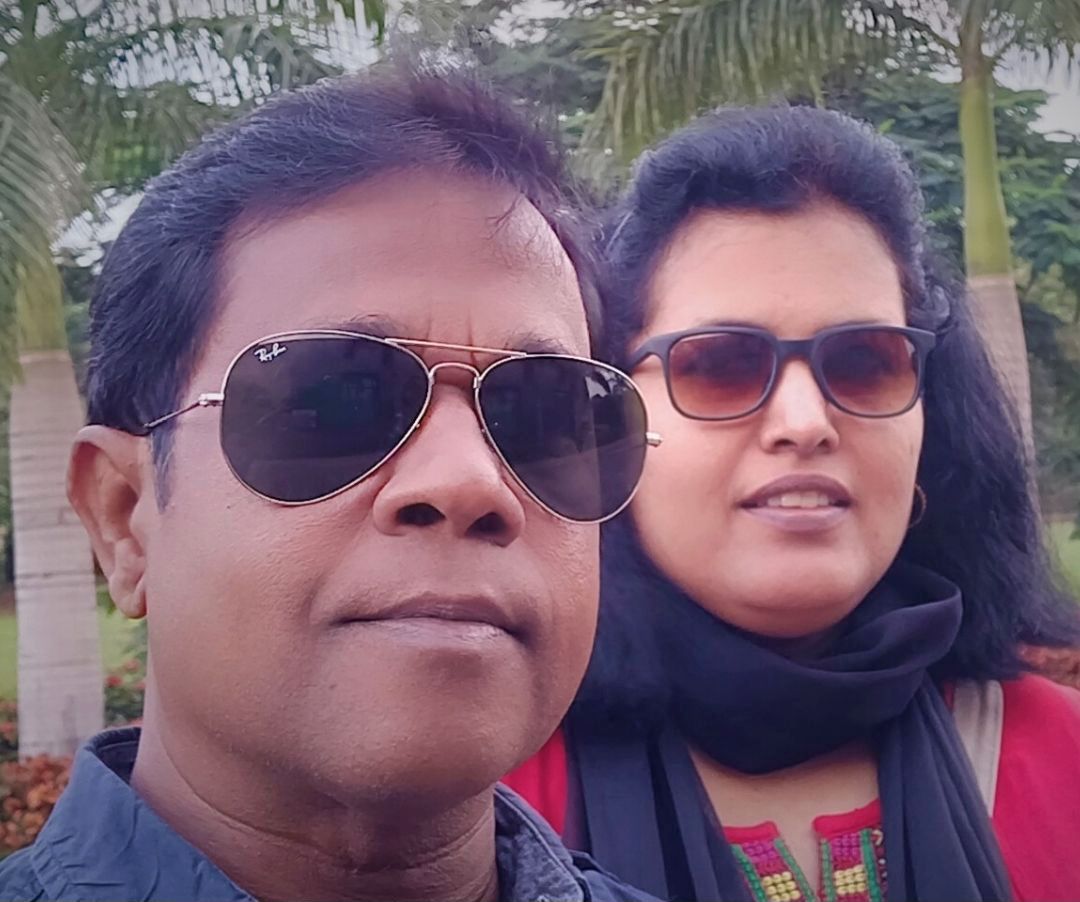
Sandy & Vyjay are a husband and wife duo who are travel content creators. They are co-founders of this travel website and are one of the leading travel content creators in India.
Sandy & Vyjay quit their successful corporate careers to pursue their passion for travel and writing full-time. Their dedication has earned them the “Best Travel Writer” award and numerous accolades on both national and international stages. Focusing on India’s destinations, heritage, and culture, they are passionate advocates for nature and the environment. Through their content, they promote ecotourism and sustainable travel, inspiring others to explore and preserve the beauty of India.