Every new app, every new account, every new service — they all want your phone number. Sign up for a messaging app? Phone number. Create an account on a marketplace? Phone number. Register for a banking service in Singapore or anywhere else? Definitely a phone number. What started as a reasonable security measure has turned into an endless cycle of handing out your most personal identifier to every platform on the internet.
The problem is not verification itself — it is that your personal phone number has become the key to everything. One number, tied to dozens or hundreds of accounts, creates a single point of failure. If that number gets leaked, spoofed, or SIM-swapped, the damage cascades across every account connected to it. And even without a security breach, giving your real number to every service means more spam calls, more marketing texts, and less control over who can reach you.
There is a better way. Virtual phone numbers let you complete SMS verification on any platform without ever exposing your personal number. In this guide, we will explain exactly how it works, what types of virtual numbers exist, where they succeed and where they do not, and how to build a practical privacy strategy around them.
Table of Contents
The Problem With Using Your Real Number Everywhere
Let us be honest about what happens when you give your phone number to a service. At minimum, it goes into a database. That database might be well-secured, or it might be sitting on an under-maintained server with last decade’s security patches. You have no way to know.
Data breaches involving phone numbers are disturbingly common. Major platforms have leaked millions of phone numbers in single incidents. Once your number is in a breach database, it gets sold, traded, and used for targeted phishing, SIM-swap attacks, and social engineering. The attacker does not need to hack your phone — they just need your number to start.
Even without breaches, there is the everyday nuisance factor. Services that have your number will text you promotions, reminders, and notifications you never asked for. Third-party data brokers aggregate phone numbers from multiple sources and sell them to marketers, recruiters, and anyone willing to pay. Your number becomes public property through a thousand small leaks.
Then there is SIM swapping — one of the most dangerous phone-based attacks. A criminal convinces your mobile carrier to transfer your number to a new SIM card. Suddenly, every verification code for every account tied to your number goes to the attacker. Bank accounts, crypto wallets, email — all compromised through your phone number. The fewer accounts tied to your personal number, the smaller your attack surface.
How Virtual Numbers Solve the Verification Problem
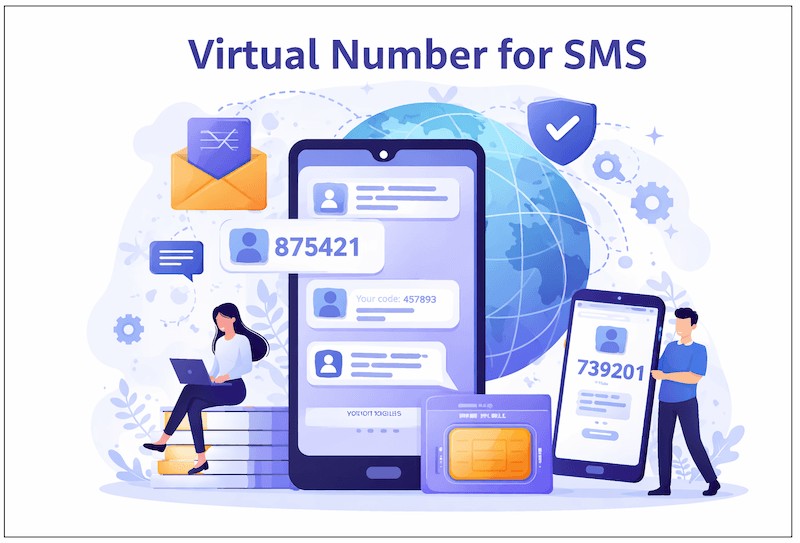
A virtual phone number is a number that exists independently of any physical SIM card or phone line. It works over the internet, and incoming calls or texts are routed to a destination you choose: your email, an app, a web dashboard, or another phone number.
For SMS verification, the concept is simple. Instead of giving a service your real +1 or +44 number, you give it a virtual number. The service sends its verification code to that virtual number. You receive the code in your email or dashboard, enter it, and the verification is complete. The service has a phone number on file, but it is not your personal one.
This creates a privacy buffer between you and every service you sign up for. If that service gets breached, the attacker gets a virtual number that does not lead anywhere useful. They cannot SIM-swap it, they cannot call your personal phone, and they cannot cross-reference it with your other accounts.
Types of Virtual Numbers for Verification
Not all virtual numbers are suitable for verification. This is the single most important thing to understand before you start, because choosing the wrong type will waste your time and money.
Disposable Numbers
Disposable numbers are temporary — they exist for a single use or a very short period. You get the number, receive one verification code, and the number disappears. They are the cheapest option, often costing a dollar or less.
Disposable numbers work well for one-time registrations where you do not plan to use the account long-term or where you will not need to re-verify later. They are great for creating throwaway accounts for testing, signing up for services you want to evaluate without commitment, or any situation where you need a quick verification and nothing more.
The downside is obvious: once the number is gone, it is gone. If the service requires you to re-verify via SMS (password reset, suspicious login detection, account recovery), you will not have access to that number anymore. For accounts you plan to keep, disposable numbers are risky.
Dedicated SMS Numbers
These are permanent virtual numbers that you rent on a monthly basis. They are yours for as long as you keep paying, and they can receive SMS messages indefinitely. Incoming texts are typically forwarded to your email or available in an online dashboard.
Dedicated SMS numbers are the right choice for accounts you intend to keep and maintain. You can tie multiple services to a single dedicated virtual number, or use different numbers for different categories of accounts (one for social media, one for financial services, one for shopping). The number stays active and available for re-verification whenever needed.
Non-VoIP Registration Numbers
This is the premium tier. Non-VoIP numbers, sometimes called SMS registration numbers, are backed by real SIM cards from actual mobile carriers. From a technical perspective, they look identical to regular mobile numbers. This matters because many platforms — particularly banks, financial services, and major tech companies — have gotten sophisticated at detecting and blocking standard VoIP numbers.
If you try to verify a bank account with a standard VoIP number, there is a good chance it will be rejected. The platform checks the number against VoIP databases and refuses it. A non-VoIP registration number passes these checks because it is technically a real mobile number, just managed virtually.
These numbers cost more (typically ten to twenty-five dollars per month), but for services where verification actually matters — banking, financial platforms, government portals — they are the only reliable option.
Which Platforms Accept Virtual Numbers (And Which Don’t)
This is the practical question everyone wants answered. Unfortunately, there is no universal rule — each platform has its own detection methods and policies. But here is a general framework based on how things work in practice.
Most social media platforms (Instagram, Twitter/X, LinkedIn, Reddit) will accept standard VoIP numbers for verification. They send a code, you enter it, done. These platforms are primarily interested in confirming you are a real person, not in verifying the type of phone line you are using.
Messaging apps are a mixed bag. WhatsApp and Telegram generally work with virtual numbers, including VoIP numbers, though WhatsApp occasionally flags numbers from known VoIP ranges. Signal tends to be stricter and may reject some VoIP numbers.
E-commerce platforms (Amazon, eBay, Shopee, Allegro) usually accept VoIP numbers for buyer accounts. Seller accounts sometimes require stricter verification.
Financial services are the strictest category. Banks, crypto exchanges, payment processors, and fintech apps frequently block VoIP numbers. For these, you will almost certainly need a non-VoIP registration number. Even then, some services have additional checks (like requiring the number to be from the same country as your account), so it is worth researching the specific platform before purchasing a number.
Government portals and official services vary by country. Some accept any number that can receive SMS. Others require a number registered to the same country, and some (particularly for sensitive services like tax portals) may require a number tied to your verified identity.
Building a Practical Privacy System with Virtual Numbers
Using virtual numbers effectively is not just about getting one number and using it everywhere. That would just replicate the problem — a single number tied to everything. The smart approach is to create a layered system.
Tier 1: Disposable Numbers for Throwaway Accounts
Use disposable numbers for services you are testing, free trials, one-time signups, and anything you do not plan to access again. This is the outermost layer of your privacy system — maximum anonymity, minimum cost, zero long-term commitment.
Tier 2: Dedicated Virtual Numbers for Regular Accounts
For services you use regularly but do not consider high-security — social media, forums, streaming services, shopping accounts — use one or two dedicated virtual numbers. These numbers are permanent, so you can always receive re-verification codes. If one of these services gets breached, the virtual number provides a buffer, and you can always change it without affecting your personal number.
Tier 3: Non-VoIP Numbers for Critical Accounts
For banking, financial services, government portals, and any account where security is paramount, use a non-VoIP registration number. These are more expensive but provide the highest compatibility and the strongest privacy protection. Keep these numbers separate from your social media and shopping numbers.
Tier 4: Your Personal Number for Almost Nothing
In an ideal setup, your actual personal phone number is tied to almost no online services. It is for calls and texts with people you know personally. It is not in any corporate database, not on any marketing list, and not associated with any online account that could be breached.
This might sound extreme, but it is actually straightforward to implement. Most people only need their personal number for contacts who already have it. Everything else can go through virtual numbers.
Country-Specific Numbers: Why Geography Matters for Verification
Many platforms require a phone number from a specific country. A Singaporean bank will not accept a U.S. number. A Polish government portal will not accept a UK number. An Argentinian marketplace will not accept a German number.
This is where choosing a virtual number provider with broad geographic coverage becomes important. If you need to verify accounts in multiple countries, you need numbers from those specific countries. Some providers offer numbers in only a handful of countries, which limits your options. Others cover 90 or more countries, giving you access to local numbers in virtually any market.
When choosing a country-specific number for verification, consider not just whether the number is from the right country, but whether it is the right type. A Singaporean VoIP number might not work for a Singaporean bank, but a Singaporean non-VoIP registration number will. Always match both the country and the number type to the platform’s requirements.
Security Considerations: Virtual Numbers Aren’t a Silver Bullet
Virtual numbers significantly improve your privacy, but they are not a complete security solution on their own. Here is an honest assessment of their limitations.
Virtual numbers do not protect against all forms of account compromise. If an attacker gets your password through phishing or a credential leak, having a virtual number for 2FA helps (they cannot intercept the code as easily as with a SIM swap), but it does not make the account invincible. Strong, unique passwords and a password manager are still essential.
SMS-based 2FA, even with a virtual number, is less secure than app-based 2FA (like Google Authenticator or Authy) or hardware keys (like YubiKey). SMS can be intercepted in rare cases, and some virtual number services have their own security vulnerabilities. For your most critical accounts, use virtual numbers for the initial registration, but switch to app-based 2FA once the account is set up.
The security of your virtual number is only as good as the provider. Choose a reputable provider with strong security practices. Look for features like two-factor authentication on your provider account itself, encrypted message storage, and a clear privacy policy that specifies they do not sell or share your data.
If you are using a virtual number for sensitive accounts, protect the provider account with a strong password and its own 2FA. If someone gains access to your virtual number dashboard, they can see all your incoming verification codes.
The Cost of Phone Privacy: Is It Worth It?
Let us talk numbers. A practical virtual number setup for privacy might look like this: one or two dedicated virtual numbers for regular accounts at eight to fifteen dollars per month each, one non-VoIP registration number for critical services at fifteen to twenty-five dollars per month, and occasional disposable numbers at one to two dollars each.
That is roughly thirty to sixty dollars per month for a comprehensive phone privacy system. Is it worth it?
Consider the alternative. The average cost of identity theft recovery in the United States exceeds one thousand dollars and dozens of hours of personal time. A single SIM-swap attack can result in losses of thousands or tens of thousands of dollars from compromised financial accounts. Even the everyday nuisance of spam calls and marketing texts has a cost in time and attention.
For most people, the cost of virtual numbers is modest insurance against real risks. For business owners, freelancers, and anyone who signs up for services across multiple countries, it is practically a necessity.
Step-by-Step: Setting Up Your First Verification Number
If you are new to virtual numbers, here is a concrete walkthrough to get started.
Decide what you need the number for. If it is a one-time verification for a low-stakes account, a disposable number will do. If it is for an ongoing account, get a dedicated number. If it is for a bank or financial service, get a non-VoIP registration number.
Choose a provider. Look for one that offers numbers in the country you need, supports the number type you need (VoIP, SMS, non-VoIP), has a clear dashboard for viewing incoming messages, and accepts your preferred payment method. Many providers now accept cryptocurrency for additional privacy.
Create an account and select your number. Most providers show you a list of available numbers in each country. Pick one and add it to your account.
Configure SMS delivery. The most common option is email forwarding — every SMS sent to your virtual number arrives in your email inbox. Some providers also offer a web dashboard, API access, or forwarding to another phone number.
Test the number before using it for anything important. Send a test SMS to it (from your real phone or from a free online SMS service) and confirm that the message arrives in your dashboard or inbox.
Use the number for verification. Go to the platform where you need to verify, enter your virtual number, wait for the code, retrieve it from your dashboard or email, and enter it. Done.
Common Questions and Misconceptions
A few questions come up repeatedly in conversations about virtual numbers and privacy.
Is using a virtual number for verification legal?
Yes, in virtually all jurisdictions. Virtual numbers are legitimate telecommunications products. Using them for account verification is a normal, legal use case. What is not legal is using them for fraud, identity theft, or impersonation — but that is true of any phone number.
Will I lose access to my accounts if the virtual number is deactivated?
Potentially, yes. If an account is tied to a virtual number for 2FA and you let that number expire, you may be locked out. This is why dedicated (permanent) numbers are important for accounts you want to keep, and why you should always set up alternative recovery methods where available.
Can platforms detect that I am using a virtual number?
Standard VoIP numbers can often be detected because they are registered in known VoIP number ranges. Non-VoIP registration numbers are much harder to detect because they are indistinguishable from regular mobile numbers. Detection technology is an ongoing arms race between platforms and virtual number providers.
Should I use the same virtual number for multiple accounts?
It depends on your privacy goals. Using one number for multiple low-security accounts is fine and cost-effective. For high-security accounts, separate numbers reduce risk — if one account is compromised, the others remain isolated.
The Bigger Picture: Phone Numbers Were Never Meant to Be Identity
It is worth stepping back and recognizing the absurdity of the current situation. Phone numbers were designed as routing addresses for telephone calls. They were never meant to be universal identity tokens, security credentials, and marketing targets all at once. But that is what they have become, and the result is a system where your ten-digit number is simultaneously used to verify your identity to your bank, deliver pizza promotions, and serve as the target for sophisticated social engineering attacks.
Virtual numbers do not fix this broken system, but they give you a practical way to navigate it with less risk. By separating your personal identity from the numbers you use for online services, you regain a measure of control that the current phone-number-as-identity paradigm has taken away.
The technology is accessible, the cost is reasonable, and the privacy benefits are immediate. Whether you start with a single disposable number for your next registration or build a comprehensive tiered system, every step away from using your personal number everywhere is a step toward better digital privacy.
We are a reader-supported site. This means, at no additional cost to you, we may earn a small commission if you book a flight or hotel, or make a purchase through one of our affiliate links. Thank you for your support!
Flights – Air India (Domestic) or Air India (International), or Priceline
Tours – Click to book top tours around the world. Book tours and activities here.
Experiences – Book your next unforgettable experience here, with flexible bookings and free cancellations. Reserve tours and activities now and pay later.
Hotels – Click to book the best hotels/resorts. Choose the best stay options with TripAdvisor or Hotels.com, or HotelsCombined
Travel Insurance – Click to book Travel Insurance that covers a range of travel insurance and safety services including medical emergencies, lost luggage, trip cancellation and more
Visas and Travel Documents Application – Click here for Online Travel Visa Check
Online Passport Photo – Get Your Passport Photo Online here


Do You Love Traveling?
Do you want to know how to travel the world? We have put together a very useful travel resources page with the best travel tips. Go check it out now. Thanks for visiting our site Voyager - imvoyager.com and taking the time to read this post! If you wish to collaborate/work with us then reach us at imvoyager18@gmail.com We’d love it if you’d comment by sharing your thoughts on this post and share this post on social media and with your friends. Follow our journey on our social media channels: Facebook X Instagram Pinterest YouTube
Start dreaming about your next adventure with Tripadvisor. Book your next unforgettable experience here with flexible bookings and free cancellations.

Flight booking online at the best fare

60+ Million Users Trust TripAdvisor With Their Travel Plans. Shouldn't You?


Sandy & Vyjay are a husband and wife duo who are travel content creators. They are co-founders of this travel website and are one of the leading travel content creators in India.
Sandy & Vyjay quit their successful corporate careers to pursue their passion for travel and writing full-time. Their dedication has earned them the “Best Travel Writer” award and numerous accolades on both national and international stages. Focusing on India’s destinations, heritage, and culture, they are passionate advocates for nature and the environment. Through their content, they promote ecotourism and sustainable travel, inspiring others to explore and preserve the beauty of India.