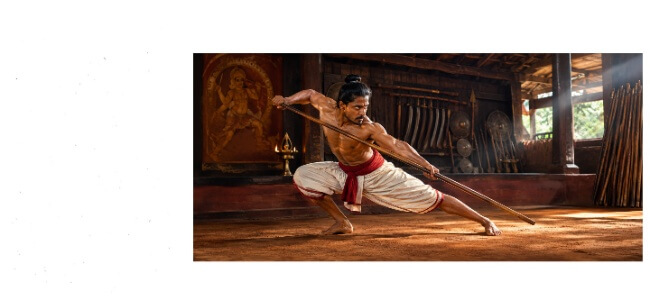
Kalaripayattu Martial Arts of Kerala is celebrated as the mother of all martial arts, with mythological roots linked to Parashurama, an avatar of Vishnu. Read on to explore its rich history, traditional techniques, training practices and enduring legacy, and discover what makes a Kalaripayattu show a captivating showcase of Kerala’s ancient warrior heritage.
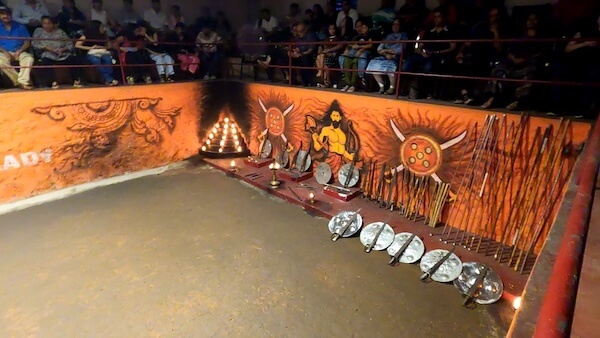
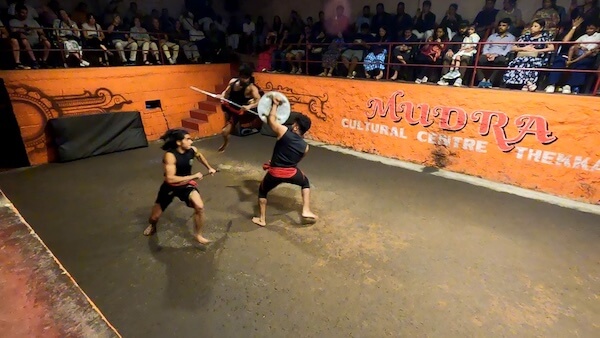
We watched a live Kalaripayattu Martial Arts performance in Thekkady, expecting to witness an ancient martial art in action. What unfolded before us, however, was far more than a performance—it was nothing short of a revelation. The arena lay sunken below ground level, while the audience sat on all four sides above, it seemed almost as though we had stepped into a miniature Roman Colosseum.
As the performers entered the arena, the air was surcharged with anticipation. Then came the first movement—swift, fluid and deliberate—and suddenly the seemingly simple arena became a world of extraordinary energy and grace. Bodies moved with astonishing agility, weapons flashed through the air, and every leap, twist and strike seemed to carry centuries of discipline within it. We found ourselves spellbound, watching not merely a Kalaripayattu show, but a living legacy of Kerala unfold before our eyes.
Table of Contents
Inside The Enigmatic World Of Kerala’s Kalaripayattu
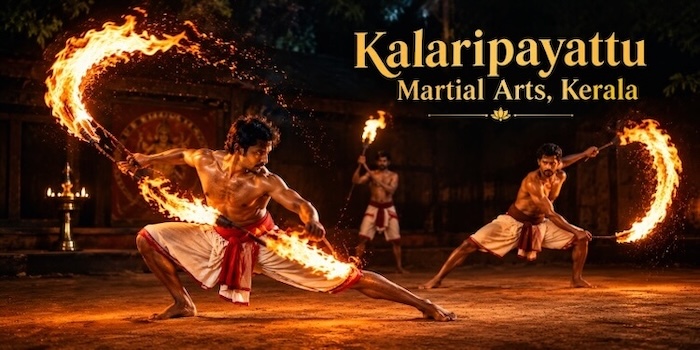
We were familiar with Kalaripayattu Martial Arts and its rich ancestry, but had never had the opportunity to witness a full-scale performance. That changed during our visit to Thekkady, as part of our Kerala journey through Munnar, Thekkady and Kumarakom, undertaken on the sidelines of Kerala Travel Mart 2026. We were privileged to witness the electrifying spectacle of Kalaripayattu unfold before us—a breathtaking display of agility, strength, precision and controlled power.
Watching A Kalarapayattu Martial Arts Show In Thekkady
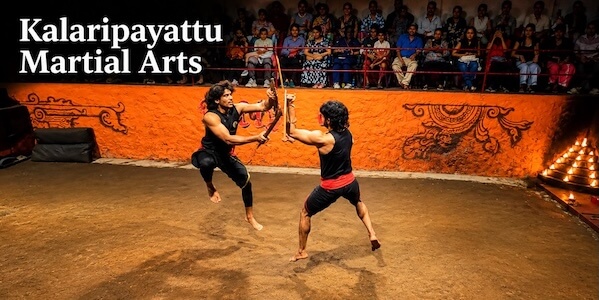
Thekkady is a land where nature unfolds in its most untamed and tranquil form—mist-shrouded Western Ghats, dense forests, spice-scented plantations and the still waters of Periyar Lake. Against this backdrop of serenity, we witnessed something dramatically different: the electrifying spectacle of a Kalaripayattu Martial Arts show at the Mudra Cultural Centre, Thekkady.
As the performers moved with explosive energy, astonishing agility and controlled power, the quietude of Thekkady seemed to give way to the primal rhythm of combat. It was a striking contrast—the stillness of the wilderness outside and the raw, pulsating energy of Kerala’s ancient martial tradition within the kalari.
It was dark as we entered the auditorium and made our way to our seats. Arranged around a rectangular arena set below us, the seating seemed almost amphitheatre-like, placing us in perfect view of the space where the drama was about to unfold. As we settled in, the lights slowly came alive, revealing the Kalari practitioners entering the arena, dressed in traditional black, their red waistbands providing a striking flash of colour.
They moved with quiet purpose to one end of the Kalari and bowed before an image of Parashurama, revered in tradition as one of the mythological figures associated with the origins of Kalaripayattu. Lamps were lit, their flickering flames casting an almost mystical glow across the arena. For a few moments, there was a sense of stillness and reverence. The audience waited in silence.
Then came the moment when the ritual gave way to action.
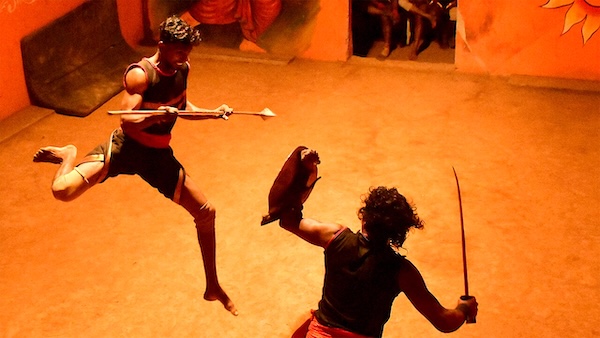
Almost without warning, the stillness was shattered. The practitioners sprang into motion, their bodies surging across the arena with astonishing speed and precision. A leap, a swift turn, a powerful strike—and suddenly the space that had moments earlier been steeped in ritual was alive with movement. Weapons flashed, feet struck the ground and bodies twisted, lunged and soared with breathtaking agility. We watched transfixed, scarcely daring to look away, as the ancient art of Kalaripayattu unfolded before us in a spectacular choreography of strength, speed, courage and control.
Kalaripayattu Martial Arts And Its Mythological Origins
The mythological origins of Kalaripayattu date back to the Treta Yuga to the times of Lord Parashurama. One of the most enduring legends associates Kalaripayattu with Parashurama, the sixth avatar of Lord Vishnu. According to tradition, Parashurama reclaimed Kerala from the sea by casting his axe into the waters. Having created the land, he is said to have established 108 kalari, or martial training centres, and imparted the knowledge of warfare and physical discipline to selected disciples. These sacred training spaces subsequently became centres where martial skills, physical conditioning and spiritual discipline were cultivated.
Another tradition connects the origins of the martial knowledge of southern India with Sage Agastya, one of the revered sages of Hindu tradition. Regarded in folklore as a master of medicine, yoga and martial wisdom, Agastya is particularly associated with the southern martial tradition of Kalaripayattu.
The kalari itself is traditionally regarded as more than a training ground. It is a sacred space where the student learns to discipline the body, sharpen the mind and cultivate inner awareness under the guidance of a Gurukkal, or master. This was evident by the fact that the Kalaripayattu practitioners first offered obeisance to an image of Parashurama, before they commenced their demonstration.
One of the most fascinating legends surrounding Kalaripayattu connects this ancient martial tradition of Kerala with Bodhidharma, the South Indian Buddhist monk traditionally believed to have travelled to China around the 5th or 6th century CE. According to popular tradition, Bodhidharma carried with him knowledge of physical discipline and martial practices, which he shared with monks at the Shaolin Temple.
Over time, this story became associated with the development of Shaolin Kung Fu and other Asian martial traditions. While the connection between Bodhidharma and Kalaripayattu remains unproven and is debated by historians, the legend continues to capture the imagination. It represents a fascinating cultural bridge between India and China and adds another intriguing chapter to the enduring story of Kalaripayattu.
Kalaripayattu was never conceived merely as a system of combat. Its traditional identity is inseparable from spirituality, discipline, healing and the belief that mastery of the body is also a path towards mastery of the self.
3 Fascinating Aspects of Kalaripayattu Martial Arts
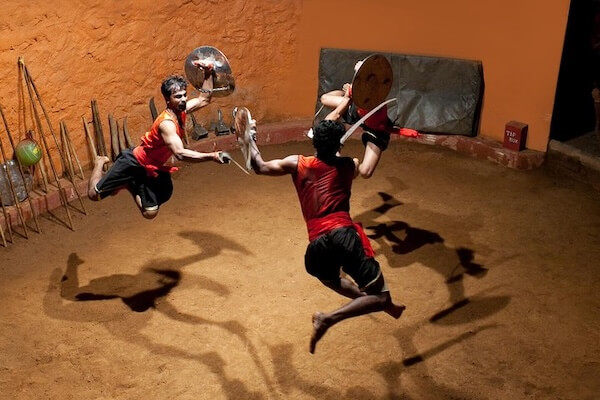
Kalaripayattu is a spectacular traditional martial art of Kerala that blends physical agility, mental discipline, graceful movements, and practical combat skills. Rooted in centuries of tradition, it is much more than a system of self-defence; it is a holistic practice that develops strength, flexibility, coordination, and concentration. From breathtaking body movements to the skilful handling of traditional weapons, Kalaripayattu reflects the rich martial heritage of Kerala. Here are three fascinating aspects that make this ancient art truly remarkable.
1. Graceful Movements and Exceptional Body Control
Kalaripayattu practitioners perform fluid sequences of leaps, high kicks, swift turns, low stances, and evasive movements. These exercises, often associated with Meipayattu, help develop flexibility, balance, stamina, agility, and coordination.
2. Mastery of Traditional Weapons
As students advance in their training, they may learn to handle weapons such as the kettukari (long staff), cheruvadi (short stick), sword and shield, and urumi (flexible sword). Each weapon requires precise timing, controlled movements, concentration, and extensive practice under an experienced instructor.
3. A Holistic Tradition of Mind, Body, and Discipline
Kalaripayattu places importance on mental focus, self-control, respect for the teacher, and disciplined practice. Some traditional schools also preserve knowledge of vital points and therapeutic practices, reflecting the broader cultural traditions associated with the martial art.
Together, these three aspects reveal why Kalaripayattu remains an enduring symbol of Kerala’s cultural identity. Whether admired for its athletic movements, traditional weapon techniques, or emphasis on discipline, this ancient martial art continues to captivate audiences and inspire practitioners in India and around the world.
Kalaripayattu Training And Kalaripayatuu Schools
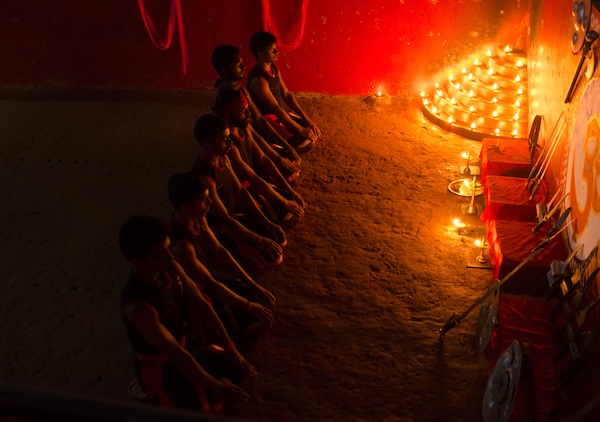
The breathtaking movements we witnessed in the Thekkady arena were not the product of a few months of practice. They were the visible expression of years of rigorous training, discipline and dedication. In the traditional kalari, a practitioner progresses through distinct stages, each building upon the physical and mental foundations established in the previous one.
The journey generally begins with Maithari, the stage of physical conditioning. Through a demanding series of exercises, stretches, jumps, kicks and body movements, the student develops flexibility, strength, stamina, balance and agility. The aim is to transform the body into an instrument capable of responding with speed and precision.
This is followed by Kolthari, the stage of training with wooden weapons. Students learn to handle different forms of sticks and staffs, mastering coordinated movements, defensive techniques and attacks. It is here that footwork, timing and awareness become increasingly important.
The next stage, Ankathari, introduces metal weapons. Training may include the sword and shield, dagger and other traditional weapons. The practitioner’s movements become more refined and demanding, requiring immense concentration and control.
The most advanced stage is Verumkai, or empty-hand combat. Having mastered the body and weapons, the practitioner learns techniques of attack, defence, locks and evasive movements without relying on a weapon. The body itself becomes the weapon.
Alongside these stages, traditional training may also incorporate Uzhichil, the therapeutic oil massage associated with Kalaripayattu, helping practitioners maintain flexibility and recover from the intense physical demands of training.
The transformation is therefore much more than physical. Under the guidance of the Gurukkal, the student gradually develops discipline, courage, concentration and control over both body and mind. Watching the practitioners in Thekkady, we could see the culmination of this extraordinary journey. Every leap, kick, turn and strike seemed effortless, yet behind that apparent ease lay years of patient practice—a journey from conditioning the body to mastering movement, and ultimately, mastering the self.
Documented History Of Kalaripayattu Martial Arts
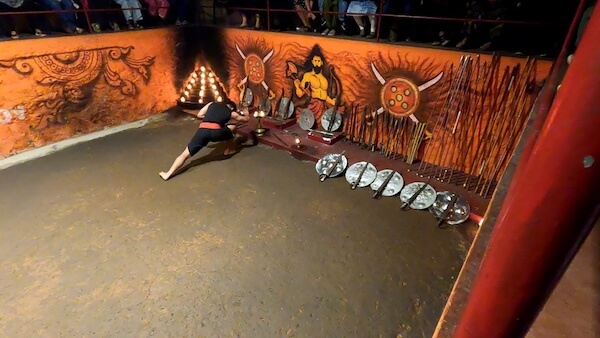
The documented history of Kalaripayattu is intertwined with the military, social and cultural history of Kerala and southern India. While its exact origins remain difficult to establish, the tradition appears to have evolved from ancient practices of combat, hunting and physical training into a sophisticated martial discipline.
Often described as one of the world’s oldest surviving martial traditions, Kalaripayattu has passed through several remarkable phases—from ancient warfare and medieval battlefields to the era of colonial suppression and, eventually, its revival in modern India and its spread across the world.
The very word Kalaripayattu offers a glimpse into its martial character. Kalari refers to a training ground or martial arena, while payattu denotes training, exercise or combat. The term kalari itself has much older literary associations.
Kalaripayattu And Sangam Literature
Ancient Tamil Sangam literature, including works such as the Purananuru and Akananuru, contains references to kalari and related martial contexts. These early references, dating broadly to the early centuries BCE and CE, do not describe Kalaripayattu as the fully developed system known today. Rather, they point to a society in which warfare, weapon training and martial skills were already an important part of life.
Sangam-era literature also provides glimpses of the weapons and combat traditions of ancient South India, including spears, swords, shields and bows. These traditions formed part of a wider Indian martial culture whose theoretical framework is also associated with Dhanurveda, the ancient Indian tradition of military science and warfare.
It is important, therefore, to see Kalaripayattu not as a martial art that suddenly appeared at a particular moment in history, but as a tradition that evolved gradually over centuries.
Evolution of Kalaripayattu During the Medieval Era
It was during the medieval period that Kerala’s martial traditions became increasingly organised and closely connected with the political and military life of the region. Between approximately the 11th and 16th centuries, the emergence of numerous local kingdoms and chieftaincies created a society in which trained warriors played an important role.
The kalari became the traditional space where young students underwent rigorous physical and weapons training under the guidance of a Gurukkal, or master. Training was not restricted simply to learning how to fight. It encompassed physical conditioning, flexibility, agility, footwork, weapon handling, discipline and, in traditional practice, aspects of healing and body care.
Kalaris were also regarded as sacred spaces. A shrine or representation of a presiding deity was traditionally incorporated into the kalari, reflecting the close relationship between martial training and spirituality.
The martial communities of medieval Kerala, particularly the Nairs and other warrior groups, played an important role in this tradition. Professional warriors were trained not only for warfare but also for ankam—formal combat or duelling undertaken in accordance with established conventions.
The exploits of these warriors live on in Kerala’s rich oral tradition, particularly the Vadakkan Pattukal, or Northern Ballads. These songs celebrate legendary figures such as Aromal Chekavar, Thacholi Othenan and Unniyarcha. Unniyarcha, in particular, occupies a remarkable place in Kerala’s martial folklore as a fearless and accomplished female warrior.
Colonial Era Supession of Kalaripayattu Martial Arts
The arrival of European powers and, eventually, British colonial rule profoundly altered Kerala’s martial culture. As traditional kingdoms and systems of warfare declined, the social and military circumstances that had sustained Kalaripayattu began to disappear.
The British were particularly wary of indigenous weapons and martial organisations in the aftermath of resistance movements and uprisings in Kerala. Restrictions on the possession and use of weapons consequently placed considerable pressure on traditional martial schools.
Kalaripayattu was pushed into decline, and many practitioners were forced to abandon public practice. Yet the tradition did not disappear completely. Gurukkals and practitioners played a crucial role in preserving the knowledge, passing techniques from one generation to another even during periods when its public practice was severely restricted.
This period of suppression became one of the most challenging chapters in the history of Kalaripayattu. But it also demonstrated the resilience of the tradition.
The early decades of the 20th century witnessed a renewed interest in India’s indigenous traditions, fuelled in part by the cultural awakening associated with the national movement. Kalaripayattu became part of a wider effort to rediscover and celebrate India’s traditional knowledge systems.
Martial schools began to reopen, teachers emerged from relative obscurity, and the art gradually returned to public life. Its techniques also found new expression beyond the battlefield.
The spectacular movements of Kalaripayattu proved particularly suited to Kerala’s performance traditions. Elements of its physical vocabulary and training have been associated with the movement and staging of forms such as Kathakali, while its influence can also be seen in other traditional performance practices.
3 Mesmerizing Styles of Kalaripayattu Martial Arts in Kerala
Kalaripayattu, one of the oldest surviving martial arts traditions of India, is deeply rooted in the cultural heritage of Kerala. Known for its graceful movements, lightning-fast strikes, powerful kicks, and disciplined techniques, this ancient martial art combines physical strength, agility, concentration, and self-control.
Traditionally practised in a kalari, a specially designed training space, Kalaripayattu has evolved through different regional traditions and teaching lineages. Three widely recognised styles are the Northern style (Vadakkan Kalari), Southern style (Thekkan Kalari), and Central style (Madhya Kerala Kalari), each distinguished by its own emphasis on movement, combat techniques, and training methods.
1. Northern Style (Vadakkan Kalari)
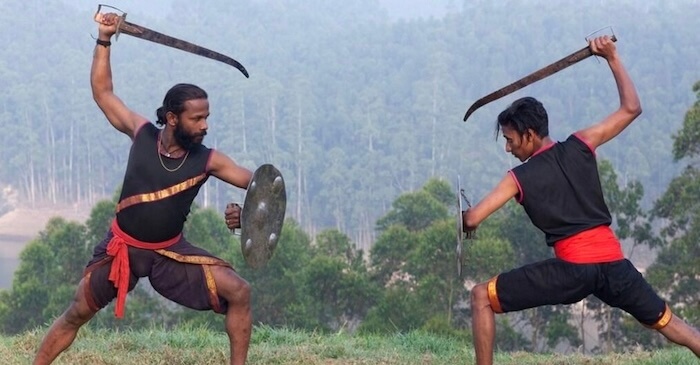
The Northern style, known as Vadakkan Kalari, is particularly associated with the Malabar region of northern Kerala and is renowned for its elaborate physical conditioning and graceful yet powerful movements. Training typically begins with meipayattu, a sequence of body-conditioning exercises designed to develop flexibility, balance, stamina, coordination, and control over the body. Practitioners learn fluid movements, high kicks, leaps, evasive techniques, and rapid changes in direction.
As training progresses, students may advance to wooden weapons such as the kettukari (long staff) and cheruvadi (short stick), followed by bladed weapons, including the sword and shield. Advanced training can also include urumi, a flexible sword that demands exceptional coordination, precision, and awareness. The style places considerable emphasis on mastering body movements before progressing to more complex combat techniques. Its flowing sequences combine speed, flexibility, and strength, creating a striking balance between athletic performance and martial discipline.
Traditional Northern-style training may also incorporate knowledge of vital points and therapeutic practices, depending on the lineage and teacher. Today, Vadakkan Kalari continues to attract practitioners interested in traditional martial arts, physical fitness, cultural heritage, and the disciplined art of self-defence.
2. Southern Style (Thekkan Kalari)
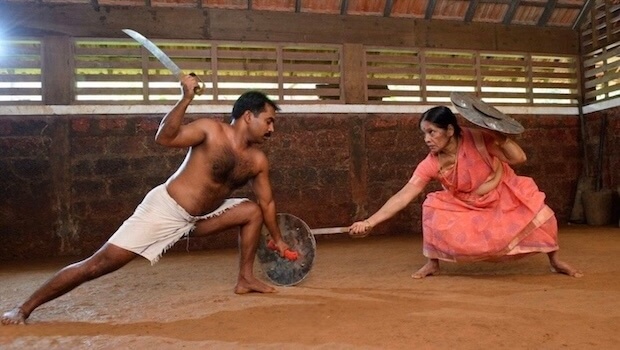
The Southern style, or Thekkan Kalari, is traditionally associated with southern Kerala and neighbouring regions of Tamil Nadu, where martial practices have developed through centuries of regional interaction. Compared with the flowing body-conditioning sequences often associated with Northern-style training, many Southern-style lineages place a stronger emphasis on direct combat applications, close-range techniques, and practical fighting movements.
Training may include strikes, blocks, footwork, grappling, and methods of unarmed combat, although the precise curriculum varies considerably between schools. Some traditions also teach weapons, including sticks and blades, as part of a broader system of martial training. Students develop quick reflexes, balance, timing, and the ability to respond to an opponent while maintaining a stable stance. Certain lineages preserve specialised methods involving vital points, traditionally understood through regional martial knowledge, though these practices should not be confused with universally established or scientifically validated claims.
The style demands mental alertness as much as physical strength because practitioners must learn to anticipate movements and react with control. Training under an experienced instructor also emphasises discipline, respect, and responsible use of martial skills. Thekkan Kalari remains an important expression of southern Kerala’s martial heritage, preserving techniques and teaching traditions passed down through generations.
3. Central Kerala Style (Madhya Kerala Kalari)
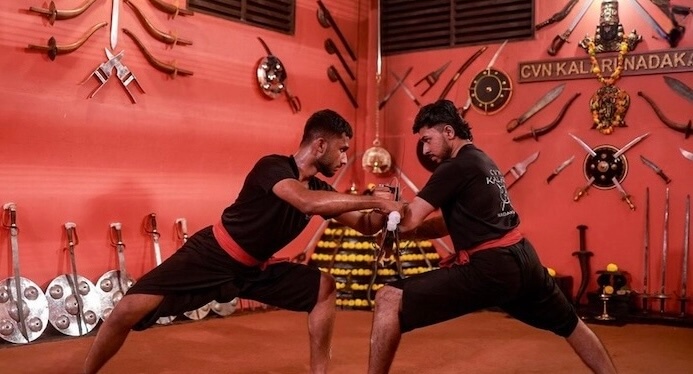
The Central Kerala style, often described as Madhya Kerala Kalari, represents martial traditions associated with the central regions of Kerala, where local teachers and training lineages have shaped distinctive approaches to Kalaripayattu. The term is used to describe regional traditions rather than a single universally standardised system, so the techniques and training sequences can differ from one kalari to another.
Practitioners may learn body-conditioning exercises, coordinated footwork, defensive movements, strikes, and weapon techniques according to their school’s curriculum. Training seeks to develop strength, agility, flexibility, balance, and the ability to coordinate the whole body during movement. Depending on the lineage, students may practise with traditional weapons such as staffs, sticks, swords, and shields as they progress through different stages of instruction. The style reflects the broader Kalaripayattu philosophy of developing the body and mind together, rather than treating martial arts as a collection of fighting techniques alone.
Regular practice encourages patience, concentration, discipline, and respect for the teacher and fellow students. As with other regional traditions, the knowledge is often transmitted through practical instruction and close observation, allowing individual teachers to preserve the methods handed down within their lineages. Central Kerala’s martial traditions therefore contribute to the rich diversity of Kalaripayattu, demonstrating how this ancient art continues to reflect the history and cultural identity of Kerala.
Kalaripayattu Schools And Kalaripayattu Today
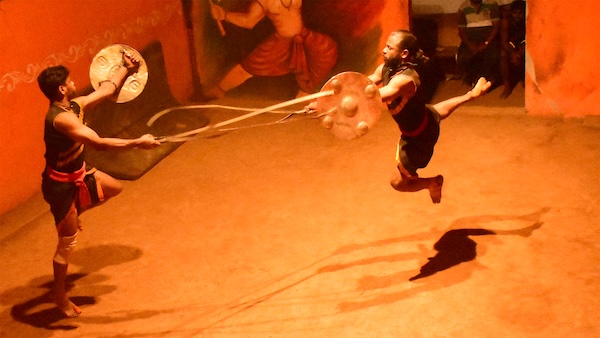
Today, Kalaripayattu occupies a fascinating space between martial art, cultural heritage, physical discipline and performance. Traditional kalari schools continue to train students in Kerala, while practitioners and teachers have taken the art far beyond India’s shores.
For some, it remains a rigorous system of martial training and self-defence. For others, it offers a pathway to physical fitness, flexibility, concentration and mental discipline. Its dramatic movements have also made it increasingly popular on stages, in films and among international audiences.
The transformation from ancient martial discipline to contemporary cultural tradition is perhaps one of Kalaripayattu’s greatest stories. It has survived changes in warfare, political upheaval, colonial restrictions and the passage of centuries, yet continues to live through the movements of practitioners in kalaris across Kerala and around the world.
And perhaps this is what struck us most as we watched the performance in Thekkady. What unfolded before us was not simply a display of spectacular kicks, leaps and weapon skills. Behind every movement was a long history—a tradition shaped by warriors, guarded by Gurukkals, preserved through generations and now being carried into the future.
The Grand Finale – Kalaripayattu – The Martial Art Form Of Kerala
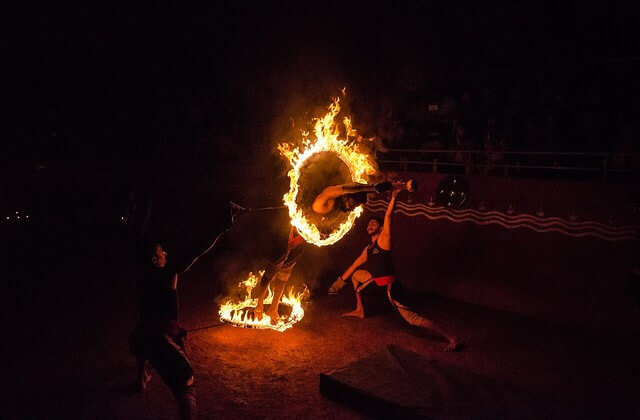
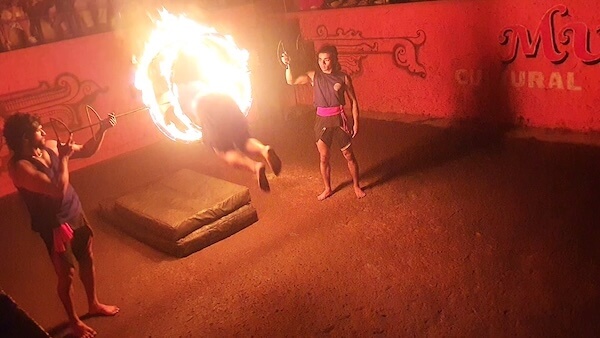
As we were lost in the mesmerizing display of Kalaripayattu at the Mudra Centre of Performing Arts in Thekkady, the performance seemed to have reached its crescendo, but the most spectacular moment was yet to come. Just when we thought the drama had ended, darkness descended once again, and flames suddenly pierced the gloom.
The Kalaripayattu practitioners returned, this time carrying fire, and the arena seemed to transform into a blazing theatre. What followed was a breathtaking display of fire stunts, as they moved around the arena with astonishing confidence, wielding and manipulating flames with seemingly effortless control. Fire circled them, sparks flew into the darkness, and for a few heart-stopping moments, it seemed as though the practitioners were literally playing with fire.
The audience watched in stunned silence, captivated by the spectacle unfolding before us. As the final flames died down, the performance came to an end, but the experience lingered. We left the arena exhilarated, carrying with us the unforgettable image of Kalaripayattu ending not with a quiet finale, but in a blaze of fire, courage and spectacle.
We hope that through our words, we have been able to transport you, even for a few moments, to that dramatic arena in Thekkady where the electrifying spectacle of Kalaripayattu unfolded before our eyes. If this journey into Kerala’s ancient martial tradition has sparked your curiosity to discover more, do subscribe to our blog and monthly newsletter for more stories, experiences and inspirations from our travels. Stay connected with us through our social media channels, and if you are planning your own journey and need information, ideas or help crafting your travel itinerary, we would be delighted to hear from you.
Where Journeys Begin — And Awareness Deepens
Pause for a breath. Imagine shorelines shimmering like quiet constellations, mountains veiled in mist and memory, and ancient streets that murmur stories with every step. This is not simply movement across maps. It is a gentle unfolding. A transformation that happens softly, almost without notice. We do not merely design itineraries; we craft experiences that feel intimate and true, like a message written directly to the heart. From peaceful sanctuaries to overlooked wonders, every journey aligns with who we are becoming.
When that inner call to explore stirs, write to us at imvoyager18@gmail.com, and together we will shape a journey that stays with us, long after the road falls quiet.
When Miles Fade — And Meaning Remains
Every journey begins before the bags are packed. It starts as a quiet pull, a sense of something waiting to be discovered. Step into a world where travel inspiration is curated with care, where hidden places, soulful encounters, and lived stories awaken curiosity. Walk beside fellow seekers who greet the day with golden light, find stillness in sacred moments, and gather joy from unplanned turns. Let these shared experiences guide us toward journeys that feel personal, alive, and unforgettable.
Travel With Us — Beyond Destinations, Into Presence
Welcome to Travel With Sandy & Vyjay, where each story opens a doorway and every image holds the warmth of a first sunrise. Wander through vibrant markets, witness the hush of temple dawns, and linger in moments that resist explanation. There are no schedules to chase here, no rush to arrive. Only curiosity, connection, and the quiet magic of discovery.
Voyager — A Gathering of Curious Spirits
Voyager is not just a travel space. It is a circle of explorers, dreamers, and storytellers. Join us on Instagram, Facebook, X Twitter, LinkedIn, and YouTube. Receive gentle sparks of inspiration through Voyager Travel Bytes on WhatsApp, or invite reflective stories into your inbox. Follow journeys on Instagram as they unfold, honest, immersive, and beautifully unscripted, just as travel is meant to be.
Journeys Shaped Around You
Whether we move softly through the world, follow distant horizons, or listen closely to the pulse of a place, every journey we create reflects our essence. Each path is chosen with intention, each detail designed to invite wonder. Because the journeys that stay with us do not simply show us new places; they quietly transform how we see ourselves.
The World Is Calling — Can You Hear It
Beyond the familiar stretches lies a world rich with beauty, meaning, and moments waiting to unfold. When our hearts tell us it is time, reach out to imvoyager18@gmail.com, and we will thoughtfully craft a travel story that lingers long after the journey ends.
Because travel has never been only about where we go. It is about who we become along the way.
And when we are ready, we simply whisper, Begin.
We are a reader-supported site. This means, at no additional cost to you, we may earn a small commission if you book a flight or hotel, or make a purchase through one of our affiliate links. Thank you for your support!
Flights – Air India (Domestic) or Air India (International), or Priceline
Tours – Click to book top tours around the world. Book tours and activities here.
Experiences – Book your next unforgettable experience here, with flexible bookings and free cancellations. Reserve tours and activities now and pay later.
Hotels – Click to book the best hotels/resorts. Choose the best stay options with TripAdvisor or Hotels.com, or HotelsCombined
Travel Insurance – Click to book Travel Insurance that covers a range of travel insurance and safety services including medical emergencies, lost luggage, trip cancellation and more
Visas and Travel Documents Application – Click here for Online Travel Visa Check
Online Passport Photo – Get Your Passport Photo Online here


Do You Love Traveling?
Do you want to know how to travel the world? We have put together a very useful travel resources page with the best travel tips. Go check it out now. Thanks for visiting our site Voyager - imvoyager.com and taking the time to read this post! If you wish to collaborate/work with us then reach us at imvoyager18@gmail.com We’d love it if you’d comment by sharing your thoughts on this post and share this post on social media and with your friends. Follow our journey on our social media channels: Facebook X Instagram Pinterest YouTube
Start dreaming about your next adventure with Tripadvisor. Book your next unforgettable experience here with flexible bookings and free cancellations.

Flight booking online at the best fare

60+ Million Users Trust TripAdvisor With Their Travel Plans. Shouldn't You?

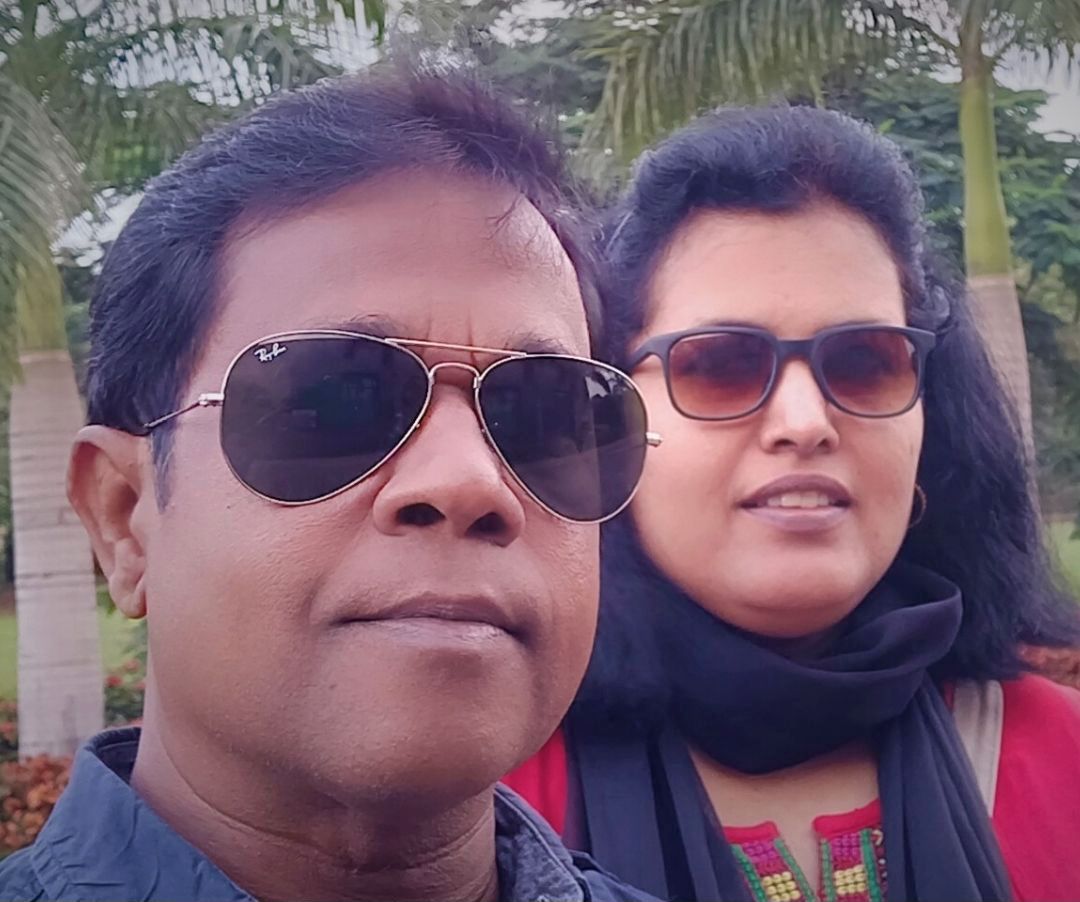
Sandy & Vyjay are a husband and wife duo who are travel content creators. They are co-founders of this travel website and are one of the leading travel content creators in India.
Sandy & Vyjay quit their successful corporate careers to pursue their passion for travel and writing full-time. Their dedication has earned them the “Best Travel Writer” award and numerous accolades on both national and international stages. Focusing on India’s destinations, heritage, and culture, they are passionate advocates for nature and the environment. Through their content, they promote ecotourism and sustainable travel, inspiring others to explore and preserve the beauty of India.