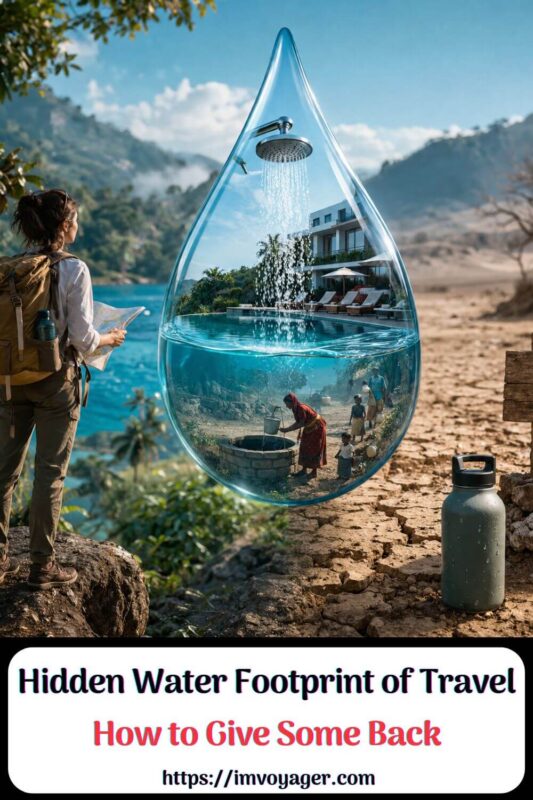
As a traveller have you thought about the water footprint of travel? The first morning of a trip has a particular feeling. You wake up somewhere unfamiliar, the light comes in at a strange angle, and you stand in the shower a little longer than you would at home. The water is hot, the pressure is good, and for ten minutes the rest of the world goes quiet.
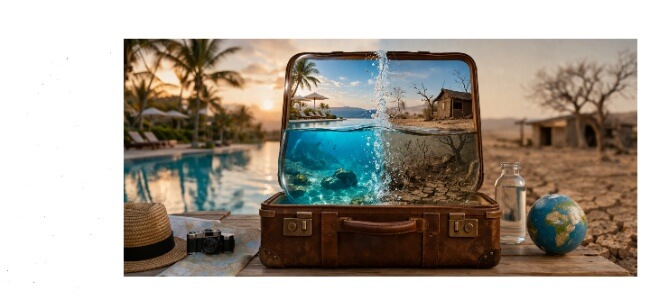
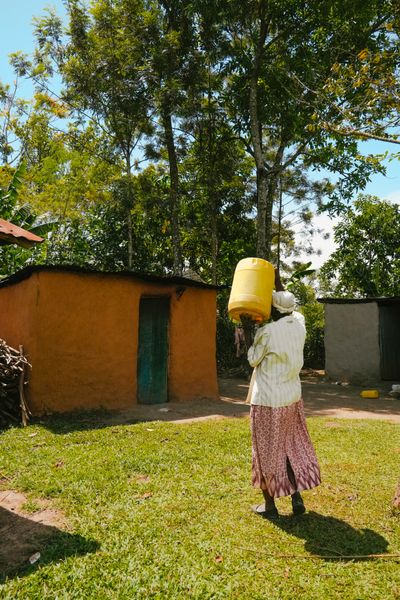
Somewhere within a few kilometers of that shower, a family may be walking to collect the day’s water by hand.
Both things are true at once, and most of us never see the second one. That gap sits at the heart of how we travel, and it is worth looking at directly, not to feel guilty, but to travel with our eyes open.
Table of Contents
Why the Water Footprint of Travel Matters More Than You Think
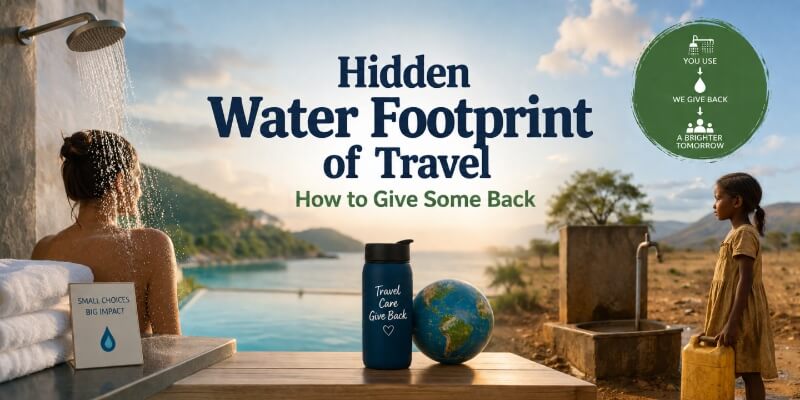
Every journey leaves an impact, and not all of it is visible. While many travellers focus on reducing plastic waste or carbon emissions, very few stop to consider the water footprint of travel. From hotel showers and freshly laundered towels to the meals we enjoy and the attractions we visit, every trip contributes to our overall travel water footprint. Understanding your water footprint is the first step towards making more informed and sustainable travel decisions. Fortunately, even small changes can reduce your water footprint without affecting the quality of your holiday.
Choosing eco-conscious accommodations, using water wisely, and supporting local conservation efforts are simple ways to embrace responsible travel. The more aware we become of our hidden water consumption, the better we can help protect precious freshwater resources for the destinations we love to explore.
The Hidden Water Footprint of Travel

When you visit a place, you use its water. That sounds obvious until you count it. A shower, a couple of meals cooked for you, laundry you never think about, a pool you swim in once, ice in a drink, a toilet that flushes with drinking-quality water. Hotels and resorts are built to make all of it feel effortless, which is exactly the problem. Effortless means invisible.
Studies of tourism have found that a guest at a hotel often uses several times more water per day than a local resident of the same town. In some dry, tourism-heavy regions the gap is stark. A visitor relaxing by a pool may go through hundreds of liters in a day while a nearby household manages on a fraction of that. The traveler is not doing anything wrong on purpose. The infrastructure simply hides the cost.
This matters more in some places than others. Fresh water is not spread evenly across the world, and neither is access to it. A liter in a rain-soaked mountain town is a very different thing from a liter in a coastal city that trucks its water in during the dry season. The same shower carries a different weight depending on where you take it. Understanding your water footprint of travel starts with accepting that the number changes with the map.
Why your travel water footprint stays invisible
Three things keep travelers from seeing their water footprint.
The first is design. A resort’s whole promise is that you stop thinking about logistics. You are meant to feel abundance. Endless towels, refilled pools, gardens kept green in a climate that does not support them. The experience is engineered to feel limitless, so scarcity never enters your mind.
The second is distance. You are a guest for a few nights. The reservoir levels, the seasonal shortages, the pipes that run dry in certain neighborhoods, none of that is your daily reality. You leave before the consequences show up.
The third is that water hides inside other things. The mango in your breakfast, the cotton in the shirt you buy at a market, the beef in a dinner you will remember for years. All of it took water to produce, often a surprising amount. Your visible use is only part of the story.
None of this is an argument against travel. Travel is one of the few things that reliably makes people more generous, more curious, and more connected to places far from home. The goal is not to stop. The goal is to carry a little awareness in your bag alongside the sunscreen.
How To Reduce Your Water Footprint On The Road | Responsible Travel
Awareness is only useful if it changes what you do. These habits lower your water use on the road without turning your trip into a chore. Most of them are small, and small adds up over a two-week journey.
Keep your showers short in dry places
This is the single biggest lever. In a water-stressed region, cutting a fifteen-minute shower to five saves more than most other efforts combined.
Reuse your towels and sheets
The little card in the bathroom asking you to hang up your towel is not corporate theater. Skipping a daily linen wash for a few days genuinely reduces laundry water, and laundry is one of a hotel’s largest draws.
Refill instead of buying
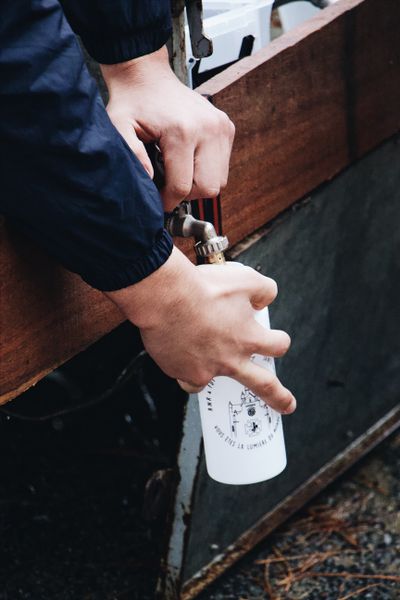
A reusable bottle and a filter or purification tablets keep dozens of plastic bottles out of the waste stream. Bottled water also carries a hidden water cost in its production, so refilling helps twice.
Eat closer to the ground
Local, plant-forward meals usually carry a smaller water footprint than imported meat and out-of-season produce flown across the world. You also tend to eat better and cheaper this way.
Choose stays that take water seriously
More small guesthouses and eco-lodges now harvest rainwater, recycle greywater for gardens, and run low-flow fixtures. A quick look at a property’s sustainability page tells you a lot about whether they think about this at all.
Ask, gently. Learning how a place gets its water is one of the more honest ways to understand it. A host who trucks in water during summer will tell you, and you will never look at that pool the same way again.
These habits shrink your footprint. They do not erase it. You will still use water you cannot fully account for, in a place that may have less of it than your home does. That leftover is where the next idea comes in.
Giving back the water you cannot cut | Reduce Your Water Footprint
You can reduce your water footprint. You cannot reduce it to zero. So the question becomes what to do with the part that remains.
The familiar answer in travel is carbon. Many travelers now offset their flights, and the idea of paying to balance an unavoidable impact is well understood. Water has lagged behind, even though for the places you actually visit, water is often the more immediate concern. A community facing a dry season feels it long before it debates its carbon budget.
This is the thinking behind Voyaqua, a free platform built after one too many trips where the gap described at the start of this piece became impossible to ignore. The premise is simple. You tell it where you are going and a little about your stay. It estimates the freshwater your trip is likely to use, then points you to a real clean-water project you can fund. Every dollar goes to the partner on the ground. The platform takes nothing.
What matters most is honesty in the number. A generic global average would be easy to calculate and close to meaningless. So Voyaqua scores each destination on local data instead. It weighs three signals for every country. The first is safety, how drinkable the local water actually is. The second is stress, the share of a country’s renewable water that is already being withdrawn. The third is value, what it genuinely costs to deliver clean water in that place. A liter in a water-stressed nation costs more to provide than a liter somewhere with water to spare, and the suggested contribution honors that difference rather than flattening it.
The result is a single fair figure that scales with the place you visited, drawn from data across 149 countries. Visit somewhere with abundant, safe water and your suggested offset is modest. Visit somewhere the rains are failing and it reflects the real weight of your stay.
The money does not vanish into a general fund. It is directed toward water projects in the country you actually traveled to, so the place that carried your footprint is the place that benefits. The founding partner is Africa Access Water, an organization building solar-powered water systems in rural, water-stressed communities. Their work has brought year-round irrigation to more than 6,000 farming households and safe drinking water to more than 30,000 people, linking water access directly to food, income, and dignity. Partners in other regions are joining so that more destinations map to real projects on the ground.
It is worth being careful here, because travel is full of feel-good gestures that quietly do very little. Offsetting is not a way to buy off a guilty conscience, and it is not a substitute for the habits above. Reducing your use always comes first. Giving back is for the honest remainder, the water you used and could not save any other way.
The kind of traveler this asks you to be
Mindful travel gets talked about a lot, and often it means nothing more than a nice photograph and a caption about slowing down. The version worth practicing is quieter and more demanding. It asks you to see the place you are in as a place people live, not a backdrop for your days off. It asks you to notice what your presence costs, and to leave a little more than you took.
Water is the clearest test of this, because it is the one resource every traveler touches every single day, everywhere, without exception. You can skip a flight. You cannot skip drinking, washing, or eating. So water is where the gap between traveler and local shows up most plainly, and where a small, deliberate act of giving back lands most directly.
The next time you take that long first-morning shower, you do not need to feel bad about it. Just remember that the water has a source, that the source is not the same everywhere, and that you have a simple way to answer for it. Travel well, use less than you are given, and give a little of it back to the places generous enough to let you visit.
That is a trip worth taking.
Frequently Asked Questions – Water Footprint of Travel
Before planning your next journey, it’s worth understanding the water footprint of travel and how your everyday travel choices affect freshwater resources. These frequently asked questions answer the most common queries about water footprint, travel water footprint, and practical ways to reduce your water footprint through responsible travel.
What is the water footprint of travel?
It is the total freshwater your trip uses, both directly and indirectly. Direct use includes showers, laundry, pools, and toilets. Indirect use is the water hidden in your food, drinks, and the products you buy along the way. In many destinations a traveler’s daily water use runs several times higher than a local resident’s.
How can I reduce my water use while traveling?
Take shorter showers in dry regions, reuse your hotel towels and sheets, refill a reusable bottle instead of buying plastic, eat local and plant-forward meals, and choose accommodations that harvest rainwater or recycle greywater. These small habits add up over the length of a trip.
Can you really offset a water footprint?
You cannot erase your water use, but you can give back the part you are unable to cut. Tools like Voyaqua estimate your trip’s freshwater footprint using local data, then direct a fair contribution to clean-water projects in the country you visited. It works best alongside reducing your use, not as a replacement for it.
Every journey leaves footprints—not just on the roads we travel, but on the planet we share. By making mindful choices and conserving water wherever we go, we can help protect precious natural resources for future generations. Travel responsibly, tread lightly, and let every adventure become a step towards a more sustainable and water-wise world. We hope you found this post informative and inspiring, we also hope that you are conscious of your water footprint on your next travel. Do subscribe to our blog for more such informative and interesting content and do not forget to subscribe to our monthly newsletter. Let us also connect on social media.
We hope you liked this post about water footprint of travel, water footprint, travel water footprint, reduce your water footprint, and responsible travel, and found it useful. Every trip we take leaves an environmental impact, but being aware of our water footprint of travel enables us to make more informed choices. Understanding your travel water footprint is an important step towards becoming a more conscious and responsible traveller.
Even simple actions to reduce your water footprint, such as taking shorter showers, reusing towels, and choosing environmentally responsible accommodations, can make a meaningful difference. Practising responsible travel also supports local communities that depend on limited freshwater resources. By making water-conscious decisions, we contribute to the broader goals of sustainable and responsible tourism.
Every mindful choice today helps preserve precious water resources for future generations of travellers and local residents alike. Let every journey inspire not only unforgettable memories but also a commitment to protecting the places we visit. Together, we can travel more responsibly while safeguarding one of our planet’s most valuable natural resources.
Do share this post about water footprint of travel, water footprint, travel water footprint, reduce your water footprint, and responsible travel with your family and friends, and also share it on your social media.
Where Every Journey Begins — And Every Moment Finds Meaning
Travel is far more than moving from one destination to another. It is an invitation to slow down, to notice the extraordinary hidden within the ordinary, and to embrace experiences that quietly reshape the way we see the world. Picture tranquil coastlines glowing beneath the morning sun, mist-covered mountains revealing timeless beauty, and ancient streets echoing with stories carried through generations. Every destination has a soul, and every journey offers an opportunity to connect with it.
We believe that travel is not measured by the miles we cover but by the memories we create and the emotions we carry home. Rather than simply planning holidays, we thoughtfully design experiences that are personal, meaningful, and deeply enriching. From peaceful retreats to hidden gems waiting beyond the tourist trail, every itinerary is crafted to reflect the traveller’s unique spirit and aspirations.
When the desire to discover somewhere extraordinary begins to grow, write to us at imvoyager18@gmail.com, and together we will create a journey that continues to inspire long after you return home.
When the Journey Ends — The Memories Live On
Every unforgettable adventure begins long before the suitcase is packed. It starts with curiosity, a dream, or a quiet feeling that somewhere beyond the horizon, something remarkable is waiting. Through carefully curated travel inspiration, authentic experiences, and stories drawn from real journeys, we invite you to discover destinations that awaken wonder. Wander through hidden corners of the world, embrace meaningful encounters, witness breathtaking sunrises, and cherish the unexpected moments that often become the most treasured memories. Every experience has the power to leave a lasting impression, inspiring journeys that feel authentic, personal, and unforgettable.
Travel With Sandy & Vyjay — Discover Beyond the Guidebooks
Welcome to Travel With Sandy & Vyjay, where every destination tells a story and every photograph captures a moment worth remembering. Explore colourful local markets, experience the serenity of ancient temples at dawn, admire spectacular landscapes, and immerse yourself in cultures that leave a lasting impression. There are no rigid itineraries here—only thoughtful exploration, meaningful connections, and the joy of discovering places through a different perspective. Every story invites you to travel more deeply, experience more sincerely, and appreciate the beauty that often lies beyond the obvious.
Voyager — A Community Built for Passionate Travellers
Voyager is more than a travel platform; it is a welcoming community of explorers, storytellers, photographers, and dreamers brought together by a shared love for discovering the world. Stay connected with us on Instagram, Facebook, X (Twitter), LinkedIn, and YouTube, where every post celebrates the spirit of exploration. Receive carefully curated travel inspiration through Voyager Travel Bytes on WhatsApp, subscribe to our newsletter for exclusive stories and travel insights, and follow our journeys as they unfold naturally on Instagram — authentic, immersive, and beautifully unscripted, just as meaningful travel should be.
Journeys Crafted Around Your Dreams
Every traveller is different, and every journey deserves to reflect that individuality. Whether you seek peaceful escapes, cultural discoveries, spiritual experiences, luxury getaways, wildlife adventures, or destinations far from the crowds, each itinerary is thoughtfully designed with purpose and care. Every recommendation, every experience, and every destination is chosen to inspire curiosity, encourage meaningful connections, and create memories that remain long after the journey has ended. Because the most memorable travels do more than introduce us to new places—they transform how we experience the world and ourselves.
The World Is Waiting — Your Next Story Begins Here
Beyond familiar paths lies a world filled with remarkable landscapes, timeless traditions, unforgettable encounters, and experiences waiting to become cherished memories. When you’re ready to begin your next adventure, write to us at imvoyager18@gmail.com, and together we’ll create a journey designed especially for you—one that continues to inspire long after you’ve returned home.
Because travel has never been only about reaching a destination. It is about discovering new perspectives, creating meaningful memories, and becoming a little richer with every journey.
Your next adventure is waiting. All you have to do is begin.
We are a reader-supported site. This means, at no additional cost to you, we may earn a small commission if you book a flight or hotel, or make a purchase through one of our affiliate links. Thank you for your support!
Flights – Air India (Domestic) or Air India (International), or Priceline
Tours – Click to book top tours around the world. Book tours and activities here.
Experiences – Book your next unforgettable experience here, with flexible bookings and free cancellations. Reserve tours and activities now and pay later.
Hotels – Click to book the best hotels/resorts. Choose the best stay options with TripAdvisor or Hotels.com, or HotelsCombined
Travel Insurance – Click to book Travel Insurance that covers a range of travel insurance and safety services including medical emergencies, lost luggage, trip cancellation and more
Visas and Travel Documents Application – Click here for Online Travel Visa Check
Online Passport Photo – Get Your Passport Photo Online here


Do You Love Traveling?
Do you want to know how to travel the world? We have put together a very useful travel resources page with the best travel tips. Go check it out now. Thanks for visiting our site Voyager - imvoyager.com and taking the time to read this post! If you wish to collaborate/work with us then reach us at imvoyager18@gmail.com We’d love it if you’d comment by sharing your thoughts on this post and share this post on social media and with your friends. Follow our journey on our social media channels: Facebook X Instagram Pinterest YouTube
Start dreaming about your next adventure with Tripadvisor. Book your next unforgettable experience here with flexible bookings and free cancellations.

Flight booking online at the best fare

60+ Million Users Trust TripAdvisor With Their Travel Plans. Shouldn't You?

Sandy & Vyjay are a husband and wife duo who are travel content creators. They are co-founders of this travel website and are one of the leading travel content creators in India.
Sandy & Vyjay quit their successful corporate careers to pursue their passion for travel and writing full-time. Their dedication has earned them the “Best Travel Writer” award and numerous accolades on both national and international stages. Focusing on India’s destinations, heritage, and culture, they are passionate advocates for nature and the environment. Through their content, they promote ecotourism and sustainable travel, inspiring others to explore and preserve the beauty of India.